

Why Capital Plans Break Under Uncertainty
Executive Summary
Most capital plans are built on an assumption that quietly expires the moment the plan is approved: that the conditions used to justify it will still be true a year later. Resilient capital planning exists precisely to close that gap, keeping investment decisions defensible no matter which future arrives.
Interest rates shift. Tariffs and trade policy move faster than procurement cycles. Supply chains reroute. Regulatory expectations tighten. Climate and extreme-weather events accelerate on a timeline no annual budget cycle was designed to absorb. Every one of these forces can, on its own, invalidate the assumptions behind a capital plan within months of sign-off.
This article examines why traditional, static capital planning breaks down under sustained uncertainty, and how leading asset-intensive organizations — across mining, manufacturing, chemicals, transportation, ports and airports — are building resilient capital planning directly into their Asset Investment Planning (AIP) discipline, so that capital plans can absorb shocks rather than shatter on contact with them.
When the Assumptions Behind the Plan Stop Holding
Capital planning has always involved uncertainty. What has changed is the frequency and severity of the shocks capital planning teams are now expected to plan around.
Trade policy and tariff conditions are shifting on a rolling, bilateral basis rather than settling into a stable baseline, and goods-sector finance leaders are reporting a sharp rise in planning uncertainty as a direct result. Elevated sovereign debt levels and continued fiscal deficit spending are keeping term premiums higher even as central banks ease rates, complicating the cost-of-capital assumptions that underpin every multi-year investment case. At the same time, economic security concerns are pulling large-scale capital toward energy, infrastructure and defense — intensifying competition for the same constrained funding pools.
None of these forces are hypothetical. They are already reshaping how finance, operations and risk teams justify capital decisions today. And they expose a hard truth: a capital plan that was defensible in January can be indefensible by the following budget cycle — not because the plan was poorly built, but because it was built to answer a single version of the future.
Industry Insight
“The organizations that come through periods of volatility strongest aren’t the ones that predicted the disruption — they’re the ones whose capital plans were built to withstand more than one version of the future.”
Why Capital Plans Break Without Resilient Capital Planning
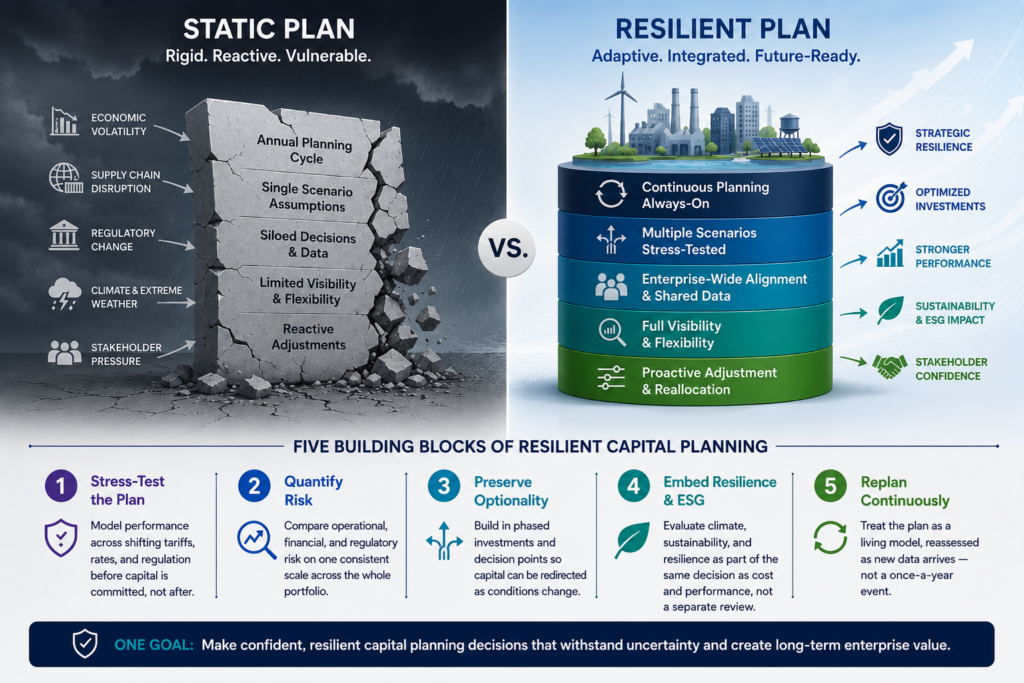
Traditional capital planning wasn’t built for this operating environment. Most capital plans break under sustained uncertainty for the same structural reasons:
- Annual, static planning cycles. Plans are locked once a year, but the conditions that justified them can shift within a single quarter.
- Single-scenario assumptions. Most plans are built and defended around one version of the future — one interest rate path, one demand forecast, one regulatory posture — leaving no structured answer for “what if this doesn’t hold?”
- Siloed risk views. Finance, operations and engineering each hold a partial view of risk, cost and performance, so trade-offs get negotiated project by project rather than resolved at the portfolio level.
- No consistent value framework. Without a common way to compare financial, operational, ESG and risk outcomes, capital tends to flow to the project that tells the most convincing story in the room — not the one that best protects enterprise value under stress.
- Disconnected data. Asset condition data, financial data and risk data live in separate systems, making it slow to see how a shock in one area ripples through the rest of the portfolio.
The result is a capital plan that looks rigorous on the day it’s approved and becomes increasingly fragile with every month that passes — precisely the failure mode resilient capital planning is designed to prevent.
Leading organizations are responding by adopting Asset Investment Planning (AIP) — a disciplined, value-based approach that enables capital plans to adapt continuously as conditions change while remaining aligned to strategy.
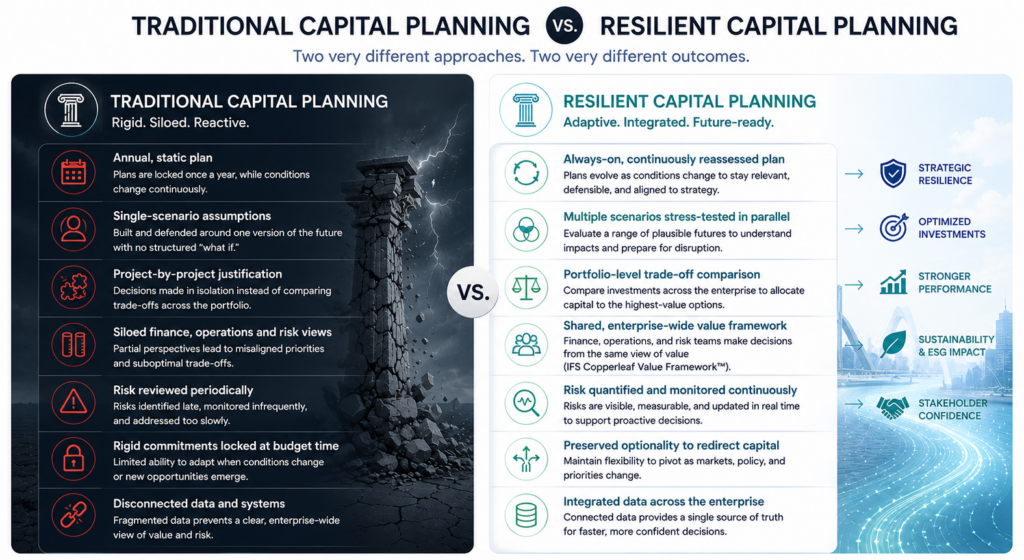
Static Capital Planning vs. Resilient Capital Planning
| Traditional Capital Planning | Resilient Capital Planning |
| Annual, static plan | Always-on, continuously reassessed plan |
| Single-scenario assumptions | Multiple scenarios stress-tested in parallel |
| Project-by-project justification | Portfolio-level trade-off comparison |
| Siloed finance, operations and risk views | Shared, enterprise-wide value framework |
| Risk reviewed periodically | Risk quantified and monitored continuously |
| Rigid commitments locked at budget time | Preserved optionality to redirect capital as conditions change |
What Resilient Capital Planning Actually Means
Resilient capital planning is often misread as an attempt to predict the future more accurately. It isn’t. No planning discipline — however sophisticated — can remove uncertainty from tariff policy, interest rates or climate risk.
What resilient capital planning actually means is building a plan that keeps its integrity no matter which future arrives: one that has already been stress-tested against multiple plausible scenarios, that preserves enough optionality to redirect capital when conditions change, and that can be defended to a board or regulator regardless of which assumptions turned out to be right.
That is precisely the discipline Asset Investment Planning (AIP) is designed to provide: a structured, transparent way to evaluate every capital decision against cost, risk, performance and strategic value — not just once a year, but continuously, as conditions evolve.
The IFS Copperleaf Value Framework™ provides a consistent way to compare financial, operational, risk, resilience, and sustainability outcomes on a common economic scale.
Five Building Blocks of Resilient Capital Planning
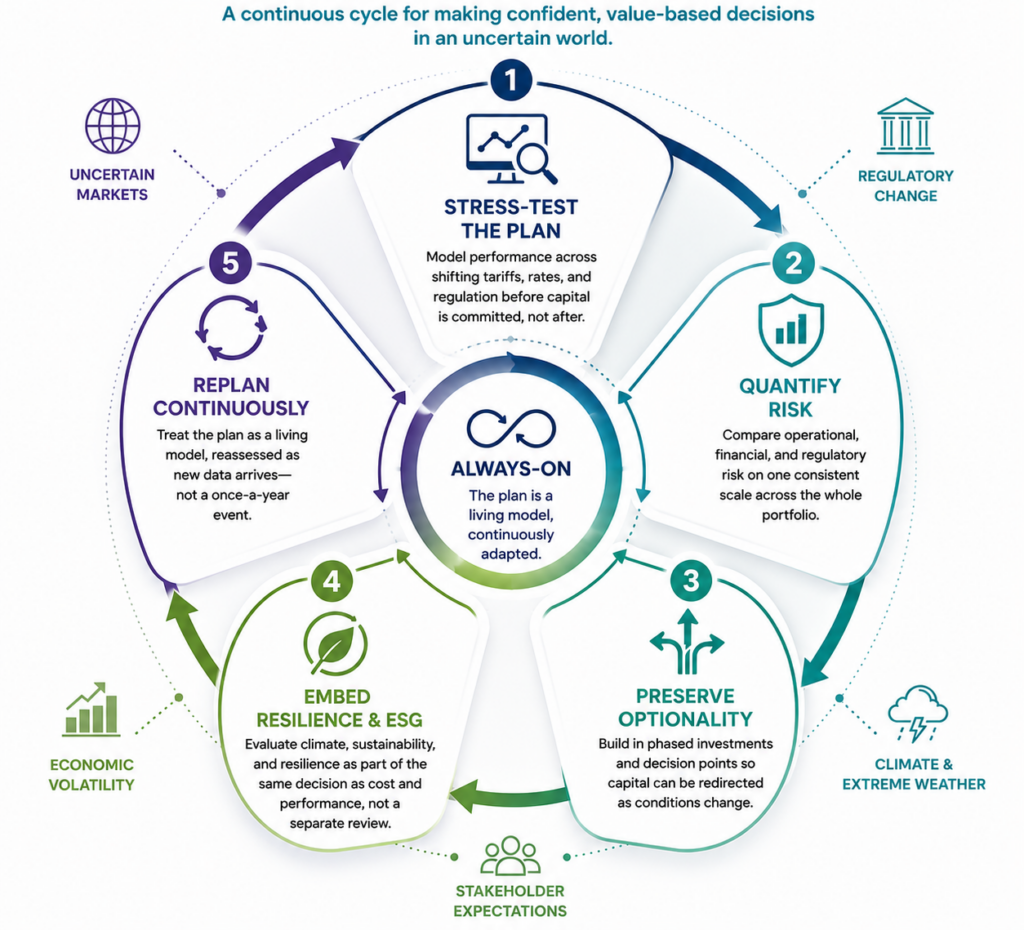
Resilient capital planning rests on five practical building blocks, applied together rather than in isolation:
-
Stress-test the plan against multiple futures.
Rather than defending a single forecast, model how the portfolio performs under a range of plausible conditions — tighter capital, shifting tariffs, delayed regulatory approval, accelerated climate risk — before capital is committed, not after.
-
Quantify risk consistently across the portfolio.
Compare operational, financial, regulatory, cybersecurity and reputational risk on a common scale, so a mining safety investment and a chemicals process-safety upgrade can be weighed against each other on equal terms.
-
Preserve capital optionality.
Resilient plans build in deliberate flexibility — phased investments, conditional triggers, and decision points — so capital can be redirected as conditions change without unwinding the entire plan.
-
Embed resilience and ESG into the value framework, not alongside it.
Climate exposure, sustainability commitments and regulatory resilience should be evaluated as part of the same investment decision as cost and performance — not as a separate, secondary review.
-
Replan continuously, not annually.
Treat the capital plan as a living model that is reassessed as new data arrives, rather than a document that is revisited once a year regardless of what has changed in the interim.
This approach aligns with the principles of ISO 55000, which encourages organizations to treat asset management as a continuous, value-driven discipline.
Why Resilient Capital Planning Matters
Independent research from IDC shows that organizations with a mature approach to resilient capital planning report measurably stronger outcomes, including:
- Up to 20% higher value realization from capital portfolios
- 5% gains in capital efficiency
- 469% average ROI
- 11-month average payback period
Beyond the measurable ROI, organizations report something harder to quantify but just as valuable: the ability to walk into a board meeting, a rate case, or an investor call and defend the capital plan with confidence — regardless of which economic assumptions shifted since it was approved.
Benefits and Challenges
Benefits
- Capital plans that hold up under changing conditions, not just at approval
- Faster, better-informed reallocation when disruption hits
- Transparent, auditable rationale for every investment decision
- Stronger governance and stakeholder confidence
- Resilience and ESG outcomes embedded in the plan, not bolted on
Challenges
- Legacy systems and fragmented data across finance, operations and engineering
- Cultural resistance to moving off annual planning cycles
- Inconsistent risk quantification across business units
- Competing short-term operational pressures against long-term resilience
- Building organizational trust in a shared, enterprise-wide value framework
How Leading Organizations Practice Resilient Capital Planning
Organizations further along the resilient capital planning journey are no longer treating resilience as a risk-management afterthought — they’re building it into how capital decisions get made in the first place.
Organizations including National Grid, Duke Energy, Anglian Water, and PG&E have applied these principles to improve capital transparency, strengthen investment governance, and support long-term infrastructure modernization.
Across every one of these examples, the common thread isn’t the software it’s a shared discipline for making capital decisions that remain defensible no matter which version of the future actually arrives.
Why Resilient Capital Planning Is Becoming a Competitive Advantage
As uncertainty becomes the operating condition rather than the exception, resilient capital planning is becoming a genuine source of competitive advantage.
- Organizations that stress-test their capital plans adapt faster when conditions shift.
- Organizations that quantify risk and value consistently make more defensible decisions under scrutiny.
- Organizations that preserve optionality can redirect capital toward the highest-value response to a shock, rather than being locked into a plan built for conditions that no longer exist.
Key Takeaways
| Challenge | Strategic Response |
| Volatile tariffs, rates and trade policy | Stress-test the plan against multiple economic scenarios |
| Ageing, higher-risk assets | Prioritize based on enterprise risk and criticality, not age alone |
| Regulatory and stakeholder scrutiny | Build transparent, auditable decision records |
| Fragmented finance and operations data | Create a shared, enterprise-wide value framework |
| Rising ESG and resilience expectations | Embed resilience and ESG directly into the plan |
| Rigid, once-a-year planning cycles | Move to continuous, always-on capital reassessment |
Summary
Capital plans don’t usually fail because the underlying analysis was wrong. They fail because they were built to defend one version of the future, in an operating environment that no longer holds still long enough for that to work. The organizations that outperform over the next decade won’t be those that predict the future most accurately. They’ll be the ones whose capital plans — built on resilient capital planning and Asset Investment Planning — are designed to adapt to it.
Frequently Asked Questions
What is resilient capital planning?
Resilient capital planning is the practice of building a capital plan that holds its integrity across multiple plausible futures, rather than one optimized for a single forecast. It relies on stress-testing, consistent risk quantification and preserved optionality to redirect capital when conditions change.
Why do capital plans break down under economic uncertainty?
Most capital plans are built around a single set of assumptions — interest rates, demand, regulatory posture — that are locked in during an annual cycle. When conditions shift faster than the plan can be revisited, the rationale behind the plan stops matching reality.
How does Asset Investment Planning help organizations build resilience?
Asset Investment Planning provides a structured, transparent framework for evaluating capital decisions against cost, risk, performance and strategic value — continuously, not just once a year — so organizations can adapt capital plans as conditions evolve without losing defensibility.
Why does this matter to boards, regulators and investors?
Boards, regulators and investors increasingly expect capital decisions to be transparent and defensible under scrutiny. A resilient capital plan can withstand that scrutiny regardless of which economic assumptions ultimately played out.