

Climate Risk Is Reshaping Rail Investment Strategy
Executive Summary
Climate change is no longer a future planning consideration it is a present-day operational and financial reality for rail infrastructure owners.
Extreme weather events, ageing infrastructure, increasing passenger expectations and tighter regulatory requirements are forcing railway organizations to rethink how they priorities capital investment. Traditional investment models, which often focused primarily on cost, asset age or replacement cycles, are giving way to approaches that weigh risk, resilience, value and long-term performance side by side.
A growing number of rail organizations are turning to Asset Investment Planning (AIP) —a structured, decision-analytics-led approach to capital planning to make better investment decisions across their entire asset portfolio. By combining engineering expertise with financial, operational and climate risk data, AIP helps decision-makers understand where investment will deliver the greatest value while improving network resilience.
This article looks at how climate risk is reshaping rail investment strategy, why railway resilience has become a board-level priority, and how decision analytics is helping operators like Network Rail make confident, defensible investment decisions.
Why Climate Risk Has Become a Strategic Investment Challenge
Railways have always been exposed to environmental conditions. What has changed is the frequency, intensity and financial impact of extreme weather.
Heatwaves increase the risk of track buckling. Heavy rainfall causes flooding, drainage failures and landslides. Storms damage overhead line equipment and signaling infrastructure.
The scale of the problem is now well documented. The European Union Agency for Railways (ERA) identified 13,469 extreme-weather events affecting Europe’s railways between 2005 and 2024, with a clear upward trend over the past decade, and found that weather-related delays over that period add up to the equivalent of one to three full years of lost railway service across the EU. Seventy percent of European infrastructure managers, representing 79% of the network by track length, say they are already seeing increasing impacts from extreme weather — yet only 37% currently use climate projections when designing new assets.
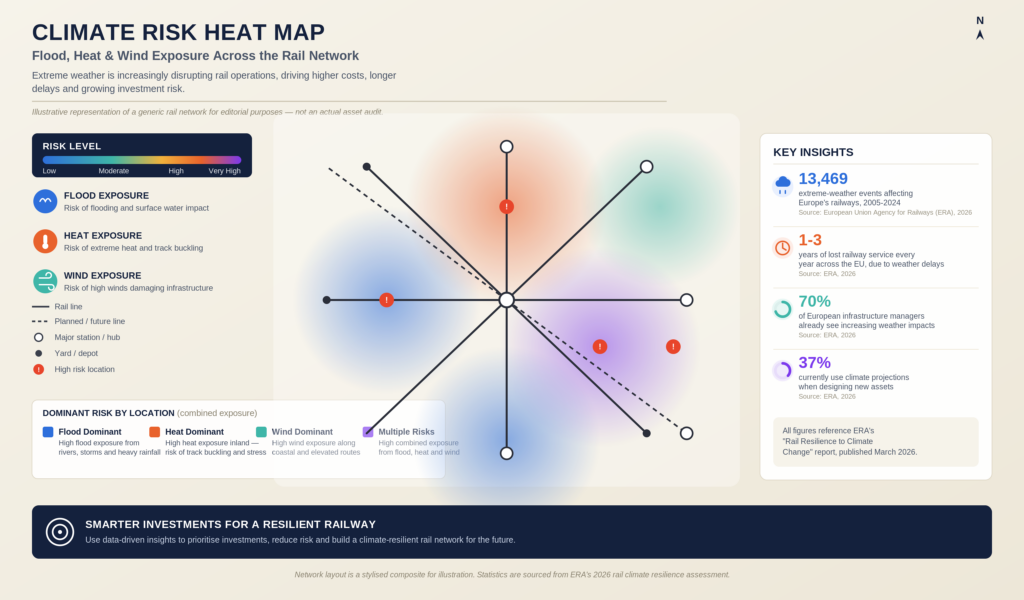
These events have direct consequences:
- Service disruption
- Passenger dissatisfaction
- Safety risk
- Increased maintenance expenditure
- Delayed capital program
- Reduced network reliability
For infrastructure owners, climate resilience is no longer solely an engineering issue — it is an enterprise investment challenge requiring collaboration across engineering, finance, regulatory affairs, sustainability and executive leadership. UIC, the International Union of Railways, has responded with its Resilient Railways guidance addressing flooding and extreme heat — a sign of how central climate adaptation has become to the industry’s agenda.
Industry Insight “Investment decisions made today will determine how resilient rail infrastructure remains for decades to come.”
Why Traditional Investment Models Are No Longer Enough
Historically, many rail organizations prioritized investment based on:
- Asset age
- Regulatory compliance
- Budget availability
- Scheduled replacement cycles
- Historical maintenance records
While these remain important considerations, climate uncertainty requires investment decisions to account for additional factors.
| Traditional Planning | Modern Climate-Resilient Planning |
| Asset age | Asset criticality |
| Cost | Value delivered |
| Replacement cycles | Risk exposure |
| Historical performance | Future climate scenarios |
| Individual assets | Portfolio optimization |
| Annual budgets | Long-term resilience |
Modern investment planning asks a different question:
Which investments will deliver the greatest long-term value while reducing operational and climate-related risk?
A New Approach: Decision Analytics and Value-Based Investment
Rather than selecting projects independently on cost or age alone, a growing number of rail organisations are turning to decision analytics: comparing thousands of competing investment options against consistent measures of risk, value and long-term performance.
Instead of asking “Which assets should we replace?”, decision-makers can ask sharper questions:
- Which investments reduce the greatest operational risk?
- Which projects improve network resilience?
- Which investment portfolio delivers the highest long-term value?
- Which deferred investments create unacceptable future risk?
Network Rail, which manages Britain’s national rail network, is one of the organisations putting this into practice. It uses decision analytics from IFS Copperleaf to evaluate investment scenarios, quantify risk, and bring engineering, finance and risk data into a single, auditable view of investment value across its infrastructure. Read the Network Rail story.
See how leading rail organizations are using value-based investment planning to improve resilience. Explore Rail Asset Risk Management
From Asset Management to Asset Investment Planning
Managing assets well is no longer enough. Today’s rail organisations must also optimise where, when and why they invest.
IFS Copperleaf’s Asset Investment Planning solutions — Copperleaf Portfolio™ and the Copperleaf Value Framework™ — apply decision analytics to evaluate thousands of competing investment options against a single, consistent value framework spanning cost, risk, performance and strategic objectives.
Learn more: Rail Asset Risk Management
The Value of Asset Investment Planning: What the Results Show
Rail operators applying this approach report measurable outcomes: up to 10% capital efficiency gains, 231% more risk mitigated, and faster regulatory approvals — built on more than 25 years of experience helping critical infrastructure organizations optimize billions in capital investment through the Copperleaf Value Framework™.
Related Resource: Strategic Investment Planning for the Future of Rail
Building Climate-Resilient Rail Infrastructure: Five Steps
Climate resilience is not achieved through one large infrastructure programme. It is built through thousands of informed investment decisions made consistently across an organisation.
A structured Asset Investment Planning process typically includes five stages.
Step 1 — Understand Climate Exposure
Identify infrastructure vulnerable to:
- Flooding
- Extreme heat
- Coastal erosion
- High winds
- Landslides
- Wildfires
Combining climate modelling historic weather data, asset location and forecast scenarios, increasingly supported by AI — with asset location data creates a clearer picture of future investment needs.
Step 2 — Understand Asset Criticality
Not every asset contributes equally to operational performance. Priorities assets based on:
- Safety implications
- Passenger impact
- Service reliability
- Network dependency
- Replacement cost
- Maintenance history
Step 3 — Evaluate Investment Scenarios
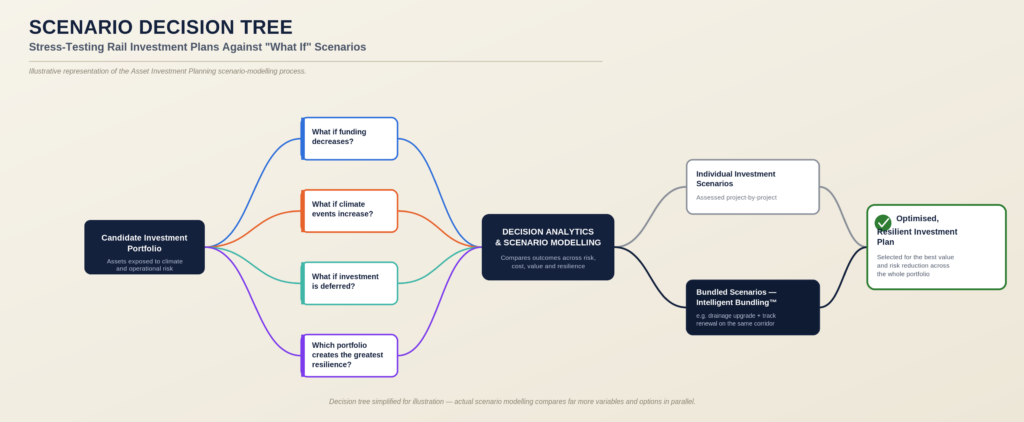
Rather than selecting projects independently, compare investment portfolios using decision analytics and scenario modelling. Questions include:
- What if funding decreases?
- What if climate events increase?
- What happens if investment is deferred?
- Which portfolio creates the greatest resilience?
Intelligent Bundling™ groups related interventions — for example, drainage upgrades and track renewals on the same corridor — so organizations can compare bundled and individual investment scenarios side by side.
Step 4 — Optimize Investment Across the Portfolio
Portfolio optimization considers multiple objectives simultaneously, including:
- Risk reduction
- Asset performance
- Budget constraints
- Sustainability goals
- Regulatory commitments
- Customer outcomes
Portfolio optimization tools such as Copperleaf Portfolio™ evaluate these trade-offs simultaneously across thousands of candidate projects — a scale spreadsheets and manual scoring cannot match. Decision analytics, increasingly enhanced by AI, can also surface patterns across a portfolio that would be difficult to spot manually.
Step 5 — Continuously Review and Adapt
Climate risk continues to evolve. Investment strategies should evolve alongside it through regular reassessment supported by updated operational, financial and environmental data.
Meeting Regulatory and ESG Expectations
Climate resilience investment does not happen in isolation from regulatory and sustainability obligations.
For regulatory and finance leaders, the Copperleaf Value Framework™ creates a transparent, auditable record of how every investment decision was scored and prioritized — making it easier to defend capital plans and rate case submissions to regulators and boards.
For sustainability and ESG leaders, the same value framework can quantify decarbonization and environmental outcomes on the same economic scale as cost, risk and reliability — so resilience investment and net-zero commitments reinforce rather than compete with one another.
Why Asset Investment Planning Matters
Organizations applying Asset Investment Planning improve how they priorities investment decisions through:
- Better visibility across asset portfolios
- Transparent and auditable investment decisions
- Improved alignment between engineering, finance and regulatory teams
- Risk-informed capital planning grounded in decision analytics
- Scenario modelling for long-term resilience
Customers report improved capital efficiency, reduced planning effort and stronger governance through value-based decision-making — outcomes reflected in Network Rail’s own experience with the platform.
Benefits and Challenges
Benefits
✔ Better capital allocation
✔ Improved operational resilience
✔ Transparent, auditable investment decisions
✔ Reduced portfolio risk
✔ Scenario modelling and risk prediction, increasingly supported by AI
✔ Improved collaboration between engineering, finance and regulatory teams
✔ Greater confidence in long-term planning
✔ Stronger regulatory and ESG alignment
Challenges
✔ Legacy systems
✔ Data quality issues
✔ Organizational silos
✔ Budget pressures
✔ Increasing climate uncertainty
✔ Balancing short-term operational needs with long-term resilience
What Leading Rail Organizations Are Doing Differently
Progressive rail infrastructure owners are moving away from isolated project decisions towards enterprise-wide investment optimization. Instead of managing individual assets independently, they are:
- Linking engineering decisions with business strategy
- Quantifying investment risk using decision analytics
- Comparing investment portfolios objectively using the Copperleaf Value Framework™
- Incorporating climate risk into planning
- Using Intelligent Bundling™ to sequence and justify investment more efficiently
This creates greater confidence that limited funding is being directed where it delivers the greatest value — for engineers, finance teams, regulators and boards alike.
Key Takeaways
| Challenge | Strategic Response |
| Increasing climate disruption | Build resilience into investment planning using decision analytics |
| Limited capital budgets | Optimize investment portfolios with Copperleaf Portfolio™ |
| Ageing infrastructure | Priorities based on risk and value |
| Regulatory and audit pressure | Use the Copperleaf Value Framework™ for defensible, transparent decisions |
| Growing ESG and stakeholder expectations | Quantify sustainability outcomes alongside cost and risk |
Summary Climate resilience is no longer simply about protecting infrastructure from extreme weather. It is about making smarter, evidence-based investment decisions increasingly supported by AI and advanced analytics that improve safety, reliability, financial performance, regulatory confidence and long-term network value. Asset Investment Planning provides the visibility and decision support needed to help rail organizations invest with confidence in an increasingly uncertain future.
Frequently Asked Questions
Why is climate risk changing rail investment strategy?
Climate-related disruptions are increasing in frequency and cost, requiring infrastructure owners to consider resilience, risk and long-term value alongside traditional investment drivers such as asset age and maintenance history.
What is Asset Investment Planning?
Asset Investment Planning is a structured approach to evaluating investment options across an asset portfolio using decision analytics and value-based optimization, enabling organizations to priorities capital investment based on value, risk, performance and strategic objectives.
How does Asset Investment Planning improve resilience?
By enabling organizations to compare investment scenarios, priorities high-risk assets and optimize investment portfolios, Asset Investment Planning helps improve network reliability while making better use of available capital.
Does Asset Investment Planning rely on AI?
The foundation of Asset Investment Planning is structured decision analytics and value-based optimization comparing investment options consistently across risk, cost and performance. AI increasingly supports parts of this process, for example in climate scenario modelling and spotting patterns across large asset portfolios, but the underlying discipline is decision analytics, not AI on its own.
Why is value-based decision-making important?
Rail organizations operate under constrained budgets. Value-based decision-making helps ensure investment delivers measurable benefits across operational performance, customer outcomes, sustainability and financial objectives.
What does climate adaptation mean for railways?
Climate adaptation means adjusting design, maintenance and investment decisions so rail infrastructure can withstand more frequent and severe weather. UIC’s Resilient Railways guidance and ERA’s recent climate resilience assessment both call for infrastructure managers to use climate projections and risk data much more systematically when planning renewals and new assets.
How does Asset Investment Planning support regulatory approval and ESG reporting?
By creating a single, auditable value framework, Asset Investment Planning gives regulatory and finance teams a transparent record of how capital decisions were made and gives sustainability leaders a consistent way to quantify decarbonization outcomes alongside cost and risk.
Ready to Build a More Resilient Railway?
Climate uncertainty should not create uncertainty in investment decisions.
By combining Asset Investment Planning, decision analytics and value-based portfolio optimisation, rail organisations can confidently prioritise investments that improve resilience, maximise capital efficiency and deliver long-term value — just as Network Rail has done.
Explore Rail Asset Risk Management: copperleaf.com/solutions-for-industry/rail-asset-risk-management
Read the Network Rail Story: copperleaf.com/company/our-clients/network-rail