

Planning for Net Zero: Managing the Shift from Gas to Electric in California
Why managing the shift from gas to electric requires a new approach to decision-making
California’s commitment to achieving carbon neutrality by 2045 is not simply an environmental target—it is a structural transformation of the energy system. Backed by legislation such as SB 100 and AB 1279, the state is driving toward a future defined by zero-carbon electricity, widespread electrification, and a steep decline in fossil fuel use.
But this transition is not just an energy challenge. It is a planning challenge of unprecedented scale—and, more importantly, a decision-making challenge.
For energy providers, the implications are immediate. Decisions being made today about infrastructure, investment, and operations will determine whether organizations can navigate the transition efficiently, or face escalating costs, stranded assets, and regulatory pressure.
Electrification Is Rewriting the Energy System
At the center of California’s strategy is a clear trajectory: electrify as much of the economy as possible and power it with clean energy.
Buildings, transportation, and parts of industry are shifting away from direct fossil fuel use toward electric alternatives. As a result, electricity demand is expected to rise dramatically over the coming decades, while natural gas demand declines.
This is not a gradual evolution. It is a structural rebalancing. Electricity becomes the dominant energy carrier, while gas moves toward a reduced and increasingly uncertain role.
What This Means for Gas-Only Companies
For gas-only providers, the transition presents a fundamental challenge to the viability of their business model. As electrification accelerates, demand for natural gas declines, particularly in residential and commercial sectors. Yet the infrastructure required to deliver gas remains capital-intensive, with high fixed costs that do not diminish as usage falls.
This creates a compounding risk. A shrinking customer base must support the same network, driving up costs per customer and increasing affordability pressures. At the same time, asset utilization drops, raising the likelihood of stranded infrastructure.
The financial consequences can be significant.
Misaligned investment or delayed action can leave billions tied up in underutilized assets, with limited pathways for recovery.”
In practical terms, this forces a new set of decisions. When should specific parts of the gas network be decommissioned? Where does it make sense to continue investing, and where should investment stop? Can infrastructure be repurposed, or should it be retired? Each of these decisions carries long-term consequences, and making them in isolation increases the risk of costly misalignment.
Without a coordinated, forward-looking approach, the risk is not just decline—but disorderly decline driven by fragmented decision-making.
The Dual-System Challenge for Combined Utilities
For organizations that operate both gas and electric networks, the challenge is even more complex. They must manage two interconnected systems evolving in fundamentally different directions. The gas network is in long-term decline, while the electric system must expand rapidly to meet growing demand.
These systems cannot be planned independently. Electrification directly affects when and where gas infrastructure can be retired. Changes in the gas network influence electric load growth. Customer behavior impacts both simultaneously.
This creates a system-level tension that must be actively managed. Retire gas too early, and the electric system may not be ready. Delay electric investment, and electrification slows. Misalign both, and the result is overbuilt infrastructure, underutilized assets, or risks to reliability.
In practice, this becomes a series of tightly linked decisions. Where should grid capacity be expanded first? How quickly can electrification be accelerated in specific regions? How should gas network retirement be sequenced alongside electric investment? Each decision shapes the others, and the margin for error is small.
The Real Challenge: Planning Across Interdependent Systems
At the heart of the transition is a fundamental shift in the nature of planning. Energy providers must now make long-term decisions in an environment defined by evolving policy, changing demand patterns, and deep interdependencies between systems. Traditional planning approaches—often siloed by function, asset class, or time horizon—are no longer sufficient.
A decision made in isolation can have cascading consequences. Accelerating electrification in one region, for example, may require simultaneous grid upgrades, revised demand forecasts, and coordinated gas network retirement. Delays or misalignment in any one area can ripple across the system.
In practice, this complexity shows up as a series of high-stakes decisions. When should assets be retired? Where should capital be deployed first? How can investments be sequenced to balance reliability, affordability, and decarbonization goals? Organizations are not making a single decision—they are making many, all interconnected, and all under uncertainty.
The cost of getting these decisions wrong is substantial. Without a coordinated view, organizations risk making billion-dollar investment decisions with only a partial understanding of system-wide impacts—leading to stranded assets, inefficient capital allocation, rising customer costs, and increased regulatory scrutiny.
A Transformation at Infrastructure Scale
Meeting California’s targets requires more than shifting energy sources—it requires rebuilding the system. Electric infrastructure must scale to support widespread electrification, requiring significant expansion of transmission and distribution networks, along with large-scale deployment of renewable generation and energy storage.
At the same time, portions of the gas system must be actively managed—downsized, repurposed, or decommissioned in a phased and strategic way.
This is not a linear transition. It is a multi-decade orchestration of overlapping systems, investments, and timelines. Success depends not just on what is built or retired, but on how well those decisions are coordinated over time.
What Integrated Planning Makes Possible
Navigating this level of complexity requires a fundamentally different approach. Integrated planning enables organizations to move from isolated decisions to coordinated, system-wide decision-making. It provides the ability to evaluate how different choices—such as accelerating electrification in a region or delaying gas network retirement—impact the broader system over time.
With this approach, organizations can align gas decommissioning with electrification timelines and grid readiness, ensuring that infrastructure transitions happen in a coordinated and reliable way. They can prioritize where to invest in electric capacity based on projected demand shifts, rather than reacting after the fact.
Integrated planning also enables scenario-based decision-making. By modeling multiple decarbonization pathways, organizations can understand trade-offs, anticipate risks, and adapt as conditions change—making decisions that remain viable under different future scenarios.
Rather than committing to isolated investments, organizations can sequence decisions over time, optimize capital allocation across systems, and reduce the risk of stranded assets. Most importantly, integrated planning connects strategy with execution—ensuring that regulatory commitments, customer impacts, and infrastructure investments are aligned within a single, coherent decision-making framework.
A Defining Capability for the Energy Transition
California’s 2045 mandate is a leading indicator of a broader global shift. The specifics will vary by region, but the underlying dynamics are consistent: electrification is accelerating, fossil fuel systems are declining, and energy networks are becoming more interconnected.
The scale of this transition is already visible in long-term system planning forecasts.
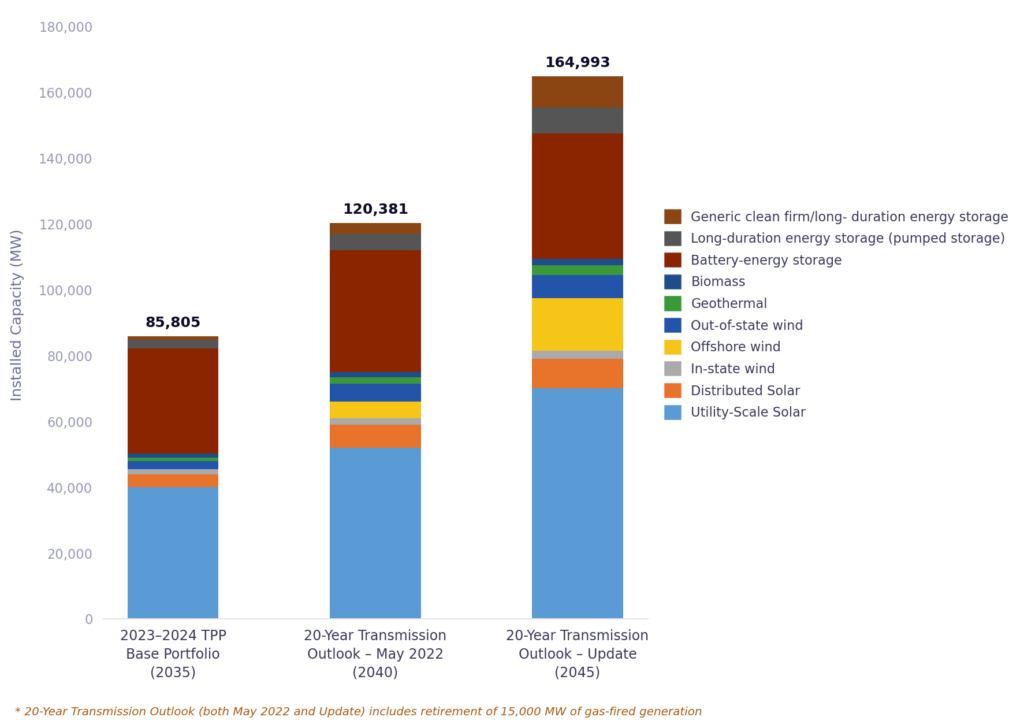
CAISO long-term outlook showing the evolution of California’s energy portfolio through 2045, with significant growth in renewable generation and storage alongside the retirement of gas-fired capacity.
Source: California Independent System Operator (CAISO), 20-Year Transmission Outlook
This shift illustrates the dual challenge utilities now face: rapidly expanding electric infrastructure while planning for the decline of legacy gas systems.
For gas-only companies, this raises fundamental questions about long-term viability and strategic direction. For combined utilities, it introduces a level of coordination challenge that cannot be addressed with traditional approaches.
Across the industry, one reality is becoming clear. The transition to net zero is not just about building new infrastructure or retiring old assets. It is about making the right decisions, at the right time, across systems that are deeply interdependent.
Organizations that continue to plan in silos will struggle to keep pace—facing higher costs, greater risk, and increasing pressure from regulators and customers. Those that adopt integrated, scenario-driven planning will be better positioned to navigate uncertainty, balance competing priorities, and lead in a system that is being reshaped in real time.
Integrated planning is no longer a supporting capability. It is the foundation for managing the energy transition.