
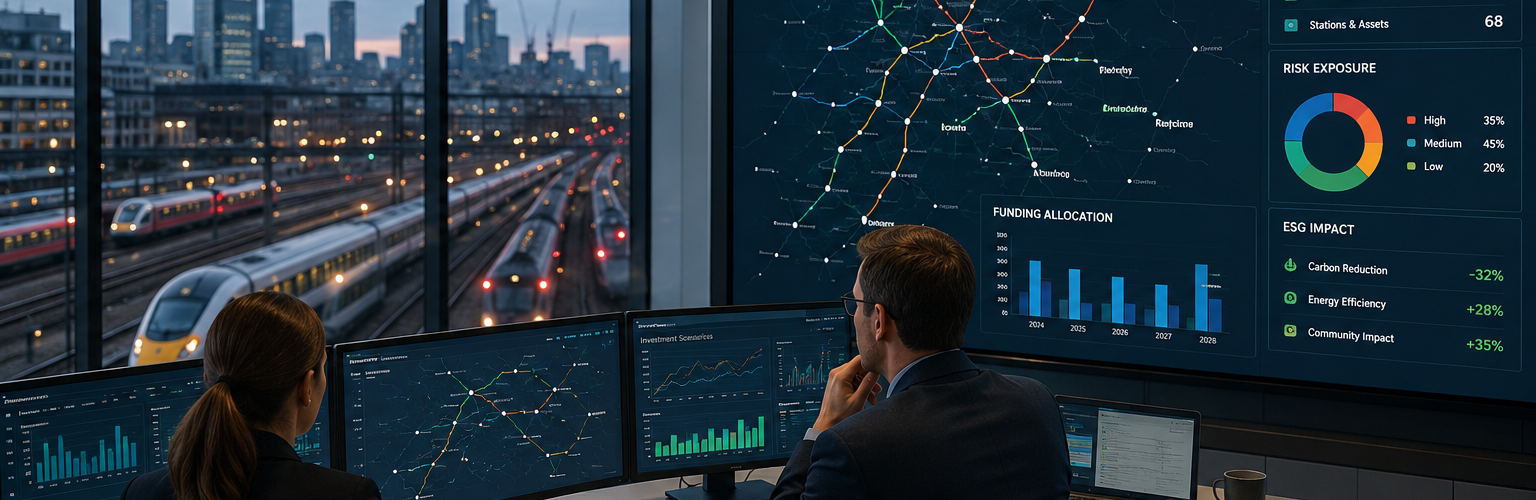
Rail Capital Investment Decisions: Turning Data Into Confidence
Executive Summary
Rail capital investment decisions are becoming more complex, more scrutinized, and more strategically important than ever before. Rail operators are under increasing pressure to modernize aging infrastructure, meet ESG commitments, improve reliability, and justify every capital investment with measurable outcomes.
The challenge is no longer a lack of data. Rail organizations already collect enormous volumes of operational, financial, and asset information. The real challenge is transforming that data into confident, defensible rail capital investment decisions.
Traditional planning approaches—spreadsheets, siloed systems, and disconnected regional models—struggle to balance cost, risk, ESG outcomes, reliability, and funding constraints at enterprise scale.
Leading rail organizations are solving this through value-based asset investment planning. By combining AI-driven optimization, scenario modeling, and a unified value framework, they are turning fragmented data into measurable, transparent, and regulator-ready capital plans.
The result:
- Stronger regulator confidence
- Up to 10% capital efficiency gains
- 231% more risk mitigated across asset portfolios
- Faster, evidence-based investment decisions
Why Rail Capital Investment Decisions Are More Complex Than Ever
Rail networks are expected to deliver more than ever before:
- Safer and more reliable service
- Net-zero and ESG outcomes
- Climate resilience
- Operational efficiency
- Transparent use of public funding
At the same time, operators face increasing pressure across multiple fronts.
| Strategic Pressure | Impact on Rail Organizations |
|---|---|
| Aging infrastructure | Higher failure risk and maintenance cost |
| Funding constraints | Difficult investment prioritization |
| ESG mandates | Pressure to quantify sustainability impact |
| Regulatory scrutiny | Greater demand for defensible planning |
| Fragmented systems | Slow and inconsistent decisions |
| Climate risk | Increased operational exposure |
For many organizations, these pressures collide inside disconnected planning processes where engineering, finance, operations, and ESG teams evaluate investments differently.
👉 The result is uncertainty, delayed approvals, and rail capital investment decisions that are difficult to defend.
The Shift from Data Overload to Rail Capital Investment Decisions Powered by AI
Most rail organizations are not short on data — they are short on alignment.
Asset systems, financial tools, GIS platforms, maintenance systems, and sustainability reporting tools each provide part of the picture but rarely connect into one decision-making framework.
Modern rail capital investment decisions require more than visibility.
They require decision intelligence.
That means being able to:
- Compare investments consistently
- Quantify trade-offs transparently
- Understand long-term risk exposure
- Align decisions to strategy
- Optimize portfolios under real-world constraints
Why Traditional Rail Capital Investment Decisions Fall Short
Historically, rail capital investment decisions relied heavily on:
- Spreadsheets
- Manual scoring
- Regional assumptions
- Siloed prioritization
These approaches create significant limitations.
| Traditional Planning | Limitation |
|---|---|
| Spreadsheet-based analysis | Difficult to scale or defend |
| Siloed regional planning | Inconsistent prioritization |
| Manual business cases | Slow and subjective |
| Separate ESG and financial analysis | Difficult trade-offs |
| Reactive planning cycles | Limited agility |
As regulatory and funding expectations rise, these limitations become increasingly risky.
A Unified Approach to Rail Capital Investment Decisions
Leading rail operators are adopting value-based asset investment planning to connect cost, risk, reliability, ESG, and performance into one transparent framework.
Using the Copperleaf Value Framework™, rail organizations can evaluate investments across:
- Safety
- Reliability
- ESG impact
- Customer outcomes
- Financial return
- Risk mitigation
…on a single economic scale.
This creates a shared decision language across engineering, finance, sustainability, and operations.
What Value-Based Rail Capital Investment Decisions Enable
| Capability | Outcome |
|---|---|
| AI-driven optimization | Highest-value investment plan under budget and resource constraints |
| Scenario modeling | Faster response to changing funding or risk conditions |
| Unified value scoring | Transparent and defensible trade-offs |
| Predictive analytics | Improved resilience and reliability |
| Full traceability | Stronger regulator confidence |
This transforms rail capital investment decisions from subjective judgment into evidence-based, value-based planning.
How AI Improves Rail Capital Investment Decisions
AI-driven optimization enables rail organizations to evaluate thousands of investment scenarios in minutes.
Instead of asking:
“Which projects should we fund?”
Rail leaders can now ask:
- Which investments reduce the most risk?
- Which projects deliver the highest long-term value?
- How do funding changes affect reliability and ESG outcomes?
- Which interventions should happen now versus later?
This creates a more agile and defensible planning process.
Learn more about AI-powered portfolio optimization.
Proof in Action: Better Rail Capital Investment Decisions at Network Rail
Network Rail uses the IFS Copperleaf® solution to support long-term asset modeling and scenario planning across one of Europe’s most complex rail systems.
By consolidating lifecycle cost models into a single enterprise planning platform, Network Rail improved visibility into investment trade-offs and strengthened alignment between strategic objectives and capital planning.
Organizations using value-based planning approaches have achieved measurable results including:
- Up to 10% capital efficiency improvement
- 231% more risk mitigated across asset portfolios
- Faster, evidence-based regulatory submissions
Read the Network Rail customer success story.
When Rail Capital Investment Decisions Become a Strategic Advantage
Forward-thinking rail operators are moving beyond reactive planning toward:
- Transparent investment justification
- Enterprise-wide planning consistency
- Stronger ESG alignment
- Faster funding approvals
- Greater resilience to climate and operational risk
In this environment, regulator confidence becomes a competitive advantage — not simply a compliance requirement.
The Future of Rail Capital Investment Decisions
The future of rail will be shaped by organizations that can:
- Turn data into confident decisions
- Quantify value consistently
- Align investment to strategy
- Defend trade-offs transparently
- Optimize capital under increasing pressure
Rail capital investment decisions are no longer just about prioritizing projects.
👉 They are about proving that every decision delivers measurable value.
Because ultimately:
The strength of tomorrow’s rail network depends on the investment decisions made today.
And every decision moves the network forward.
Conclusion
In modern rail operations, confidence is not built through data alone it is built through the ability to turn data into clear, defensible action.
By combining value-based decision-making, AI-driven optimization, and unified planning frameworks, rail operators can:
- Improve capital efficiency
- Quantify ESG and risk outcomes
- Strengthen regulator confidence
- Align strategy with execution
- Build more resilient rail networks
IFS Copperleaf® helps rail organizations transform data into confident rail capital investment decisions — ensuring every investment delivers measurable long-term value.
Ready to Make Every Rail Capital Investment Decision Defensible?
Discover how IFS Copperleaf® helps rail operators align cost, risk, ESG, and performance into transparent, value-based investment plans that improve regulator confidence and long-term network resilience.
Frequently Asked Questions
1. What are rail capital investment decisions?
Rail capital investment decisions are the choices rail operators and transit agencies make about how to allocate funding across renewals, upgrades, resilience programs, ESG initiatives, and infrastructure modernization.
2. Why are rail capital investment decisions becoming more difficult?
Aging infrastructure, ESG mandates, climate risk, funding constraints, and increasing regulatory scrutiny are making investment decisions more interconnected and difficult to prioritize.
3. How does AI improve rail capital investment decisions?
AI-driven optimization evaluates thousands of investment scenarios to identify the highest-value capital plan within funding, timing, and resource constraints.
4. What is value-based decision-making in rail?
Value-based decision-making evaluates investments on a common economic scale that includes financial, operational, ESG, reliability, and risk outcomes.
5. How does IFS Copperleaf help rail organizations?
IFS Copperleaf enables rail operators to optimize investment portfolios, quantify trade-offs, strengthen regulator confidence, and align capital decisions with long-term strategic goals.