
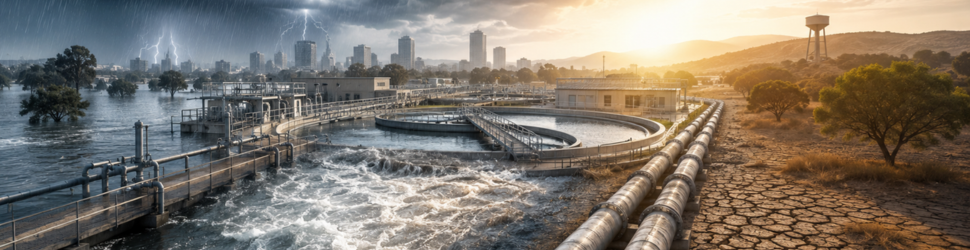
Preparing for Climate Volatility in Asset Planning
Executive Brief
Climate volatility is reshaping how water utilities allocate capital, manage risk, and maintain long-term service resilience. Floods, droughts, heatwaves, and wildfire impacts are no longer isolated events—they are recurring operational realities that directly affect asset performance, regulatory compliance, customer service, and long-term infrastructure resilience.
Traditional asset planning approaches, which rely heavily on historical climate patterns and static risk assumptions, are becoming less reliable. Utilities now need investment frameworks that integrate climate exposure, asset vulnerability, operational consequences, and resilience outcomes into transparent, evidence-based decision-making.
This article examines how climate volatility affects water and wastewater infrastructure, why conventional planning approaches are under pressure, and how utilities can translate uncertain climate risks into targeted, defensible capital investment strategies. It also outlines how IFS Copperleaf helps utilities embed climate-informed risk into portfolio planning and capital prioritization.
Turning Climate Risk into Defensible Capital Investment Decisions for Water Utilities
Climate volatility is reshaping how water utilities allocate capital, manage risk, and maintain long-term service resilience. Floods, droughts, extreme heat, and wildfire risks are no longer isolated events—they are recurring operational realities that directly affect infrastructure performance, regulatory compliance, customer outcomes, and long-term asset investment planning.
Utilities increasingly face compounding climate extremes: intense rainfall that overwhelms wastewater and stormwater systems, followed by prolonged dry periods that stress supply assets, degrade water quality, and accelerate asset deterioration.
The challenge is no longer recognizing climate risk. The challenge is converting uncertainty into capital investment decisions that are targeted, defensible, and aligned with service levels, regulatory obligations, and long-term resilience goals.
Why Climate Volatility Changes Asset Planning
Traditional asset planning has historically relied on past performance data and relatively stable climate patterns. That approach is becoming less reliable as climate conditions evolve faster than typical planning cycles.
Climate volatility introduces three major realities that directly affect water utility investment planning.
1. Hazards Are More Frequent and Less Predictable
Flood and drought risks now fluctuate significantly from year to year, changing both the likelihood and consequences of asset failure across treatment, conveyance, storage, and distribution systems.
Infrastructure designed for historical climate assumptions may no longer perform reliably under current conditions.
2. Failures Cascade Across Systems
Climate events rarely affect a single asset in isolation. Flooding can trigger pump outages, power disruptions, contamination risks, treatment upsets, and transportation access issues simultaneously.
The result is compounded operational and customer impacts across water, wastewater, and stormwater systems.
3. Regulators Expect Demonstrable Resilience Planning
Regulators increasingly expect utilities to show that climate risks are understood, quantified, and incorporated into investment planning—particularly where public health, environmental compliance, and service reliability are affected.
Utilities must now demonstrate not only that they understand climate risk, but also how investment decisions reduce that risk.
The implication is clear: climate risk must become a core input into capital prioritization rather than a qualitative overlay or supporting narrative.
How Floods and Droughts Increase Asset Vulnerability
Understanding how climate hazards translate into infrastructure risk is essential for defensible planning.
Flood Impacts Include
- Infiltration and inflow (I&I) surges that exceed treatment capacity
- Failure of submerged electrical and control assets
- Erosion and scour affecting buried infrastructure
- Expanded contamination pathways
- Restricted site access that prolongs outage duration and increases customer impact
Even when infrastructure remains operational, flood events often accelerate long-term deterioration and increase lifecycle costs.
Drought Impacts Include
- Increased pressure on alternative water sources and treatment processes
- Elevated water quality risks caused by low storage levels and higher temperatures
- Soil movement contributing to pipe failures
- Catchment degradation from wildfire and extreme heat
- Shifting customer demand patterns that expose hydraulic weaknesses
Together, floods and droughts create both acute failure risks and chronic infrastructure degradation, increasing long-term capital requirements and operational exposure.
From Climate Risk to Defensible Investment Decisions
Most water utilities already possess elements of climate insight, including hazard maps, condition assessments, incident histories, and capital backlogs. What is often missing is a consistent decision framework that connects those inputs directly to investment priorities.
Effective climate-informed asset planning typically includes five core steps.
1. Identify Climate Hazards and Asset Exposure
Determine which assets are exposed to flood, drought, heat, wildfire, or coastal risks based on location, elevation, criticality, and network role.
2. Translate Exposure into Quantified Risk
Incorporate factors such as asset condition, design standards, redundancy, recovery complexity, customer impact, and environmental consequence to assess vulnerability and consequence.
3. Define Intervention Options
Develop practical investment responses, including renewals, hardening measures, capacity upgrades, operational changes, and resilience improvements.
Quantify how each intervention reduces risk or improves service outcomes.
4. Prioritize Using Transparent Decision Logic
Evaluate resilience investments alongside renewal, compliance, and growth needs using consistent criteria across cost, risk reduction, customer outcomes, and regulatory performance.
5. Build a Defensible Planning Narrative
Ensure investment decisions can be clearly explained to regulators, executives, boards, and stakeholders:
- What was prioritized
- Why it matters
- What risks are reduced
- How outcomes align with strategic objectives
How IFS Copperleaf Supports Climate-Informed Asset Planning
IFS Copperleaf helps water utilities integrate climate risk directly into asset investment planning so resilience decisions become evidence-based, repeatable, and defensible.
Utilities use IFS Copperleaf to:
- Quantify and compare climate-driven risks across infrastructure portfolios
- Evaluate trade-offs between resilience, renewal, compliance, and growth investments
- Optimize capital plans within funding and delivery constraints
- Demonstrate how investments reduce operational and regulatory risk
- Continuously adapt plans as climate conditions, asset performance, and regulatory expectations evolve
Using the IFS Copperleaf Value Framework, utilities can evaluate resilience improvements, regulatory obligations, customer outcomes, operational risks, and financial impacts on a common economic scale. This enables transparent, value-based decision making across competing capital priorities.
Rather than treating climate volatility as an external uncertainty, utilities can incorporate it as a structured input into better capital planning decisions.
Planning with Confidence in a Volatile Climate
Climate volatility is forcing water utilities to move beyond static, history-based asset planning. Utilities that succeed will be those that can translate uncertainty into clear, risk-informed investment priorities.
By integrating climate risk into asset investment planning, utilities can build capital plans that are not only more resilient, but also more transparent, explainable, and defensible in the face of increasing operational and regulatory pressure.
Utilities that can clearly demonstrate how capital investments improve resilience, reduce enterprise risk exposure, and support long-term strategic objectives will be better positioned to secure funding, strengthen regulatory confidence, and maintain stakeholder trust in increasingly volatile operating environments.
Frequently Asked Questions
Why is climate volatility becoming a major issue for water utilities?
Climate volatility increases the frequency and severity of floods, droughts, heatwaves, and wildfire-related impacts. These events directly affect infrastructure performance, operational reliability, water quality, and regulatory compliance.
Why are historical planning models no longer sufficient?
Historical climate patterns are becoming less reliable predictors of future conditions. Infrastructure designed for past weather assumptions may not perform effectively under increasingly variable climate conditions.
What is climate-informed asset planning?
Climate-informed asset planning integrates climate exposure, asset vulnerability, operational consequences, and resilience outcomes into investment prioritization and capital planning decisions.
How do floods affect water and wastewater infrastructure?
Floods can overwhelm treatment systems, damage electrical assets, increase contamination risks, erode buried infrastructure, and extend outage durations due to restricted site access.
How does drought affect infrastructure risk?
Drought conditions can increase pressure on alternative supply sources, elevate water quality risks, contribute to pipe failures through soil movement, and expose network capacity limitations.
What makes a capital investment decision “defensible”?
A defensible decision is supported by transparent risk analysis, clear prioritization logic, measurable outcomes, and alignment with regulatory, operational, and customer service objectives.
How can utilities prioritize resilience investments against other capital needs?
Utilities can use risk-based planning frameworks to compare resilience investments alongside renewal, compliance, and growth programs using consistent evaluation criteria.
How does IFS Copperleaf support climate resilience planning?
IFS Copperleaf helps utilities quantify climate-related risks, evaluate investment trade-offs, optimize constrained capital plans, and demonstrate how investment decisions improve resilience and reduce risk.
What are regulators expecting from utilities?
Regulators increasingly expect utilities to demonstrate that climate risks are quantified, actively managed, and reflected in investment planning and resilience strategies.
What is the long-term benefit of climate-informed planning?
Climate-informed planning helps utilities improve resilience, reduce lifecycle costs, support regulatory compliance, and maintain reliable customer service under increasingly volatile climate conditions.