
Smart Water Metering: From Data to Better Investment Decisions
Executive summary
Smart water metering changes how utilities operate. Advanced Metering Infrastructure (AMI) delivers detailed consumption data that helps utilities spot leaks, understand demand, drive conservation, and improve service. But the real payoff comes when utilities connect these insights to investment planning.
When utilities combine smart-meter data with asset, risk, and operational information, they make better decisions about where and when to invest. IFS Copperleaf Asset Investment Planning (AIP) helps water utilities evaluate trade-offs, run scenarios, and prioritize spending against strategic goals and real-world constraints.
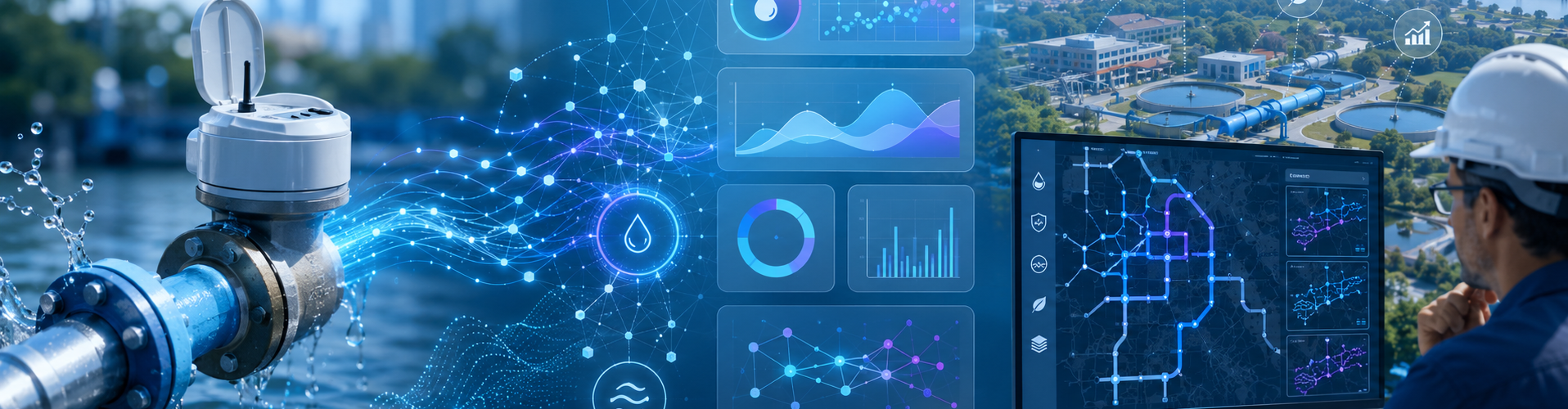
The progression is simple: smart-meter data → operational insight → investment decisions → measurable value.
Smart water meters do more than billing
For decades, water meters had a single job: measuring consumption for billing. Today’s smart meters deliver far more.
Traditional meters offered a limited picture—typically one reading per month or quarter. Changes in water use stayed hidden. Anomalies went unnoticed. Patterns remained unclear.
AMI changes all that. Smart meters collect consumption data automatically and transmit it in real time. Utilities get detailed, frequent snapshots of water use across their entire network.
What utilities can do with this data:
- Detect leaks early. Unusual or continuous consumption often signals a customer-side leak or irrigation problem. Earlier detection cuts water loss and improves customer service.
- Understand demand patterns. Peak demand, seasonal variation, and usage trends become visible. Utilities can forecast more accurately and align infrastructure to actual need.
- Track non-revenue water. When consumption data combines with network and operational information, utilities see water balances and losses more clearly.
- Support conservation. Utilities can measure the real impact of demand-management programs and give customers clearer visibility into their own use.
- Respond faster to issues. Billing questions, service problems, and consumption anomalies get resolved with facts instead of guesses.
For utilities, that visibility matters. It reveals where infrastructure is stressed, where demand is climbing, and where investment may be needed.
Moving from operational insight to investment strategy
Water utilities face hard choices. Assets age. Communities grow. Climate risks mount. Regulators and customers demand reliability. But budgets are tight and funding is limited.
More consumption data doesn’t solve these trade-offs. Utilities still need to decide which projects should go first, when they should happen, and which mix of investments delivers the most value within available resources.
That’s where Asset Investment Planning (AIP) comes in.
AIP is a structured way to evaluate competing options. Instead of treating each infrastructure need separately, utilities assess investments against measures like cost, risk, performance, sustainability, and strategic alignment. They compare different approaches, understand long-term consequences, and defend their spending decisions.
AMI data strengthens this process. If consumption data shows sustained demand growth in one service area, that insight contributes to decisions about capacity expansion, timing, and how that investment stacks against other portfolio priorities.
The key shift: moving from viewing AMI as an operational tool to using it as input for broader investment decisions.
Connecting data to make smarter decisions
Smart-meter data gains power when combined with other information water utilities already have:
- Asset condition and performance data
- Geographic information systems (GIS) and network models
- Customer and consumption history
- Maintenance and operational records
- Financial constraints and available capital
- Risk assessments
- Demand and capacity forecasts
Bringing these together lets utilities understand not just what’s happening, but which actions deliver the most value.
IFS Copperleaf Asset Investment Planning helps water utilities answer strategic questions:
- Which investments reduce risk the fastest?
- Where will additional capacity create the most value?
- What changes if available funding drops?
- Which projects should move forward, and why?
- Which can wait, and what’s the cost of delay?
- How do trade-offs play out across the portfolio?
Instead of making investment calls in isolation, utilities evaluate projects as a portfolio and see the consequences clearly.
Building resilience and sustainability
Smart water metering supports broader resilience and sustainability goals in concrete ways.
Better consumption data helps utilities measure whether conservation programs actually work. It catches leaks before they become expensive problems. Automated meter reading reduces field labor.
More importantly, utilities gain the evidence they need to invest with confidence. They can evaluate projects not only on financial cost but on their impact to reliability, environmental outcomes, customer service, and long-term sustainability.
This broader view becomes essential as utilities balance immediate operational needs with long-term infrastructure health.
Making smart metering deliver real value
A successful smart-metering program is more than technology deployment. Utilities need data governance, analytics capability, cybersecurity, customer communication, and cross-team collaboration. They need a clear answer to one critical question:
What decisions will we make better because we have this data?
That’s the question that matters.
When AMI insights connect to asset investment planning—when consumption data combines with risk, financial, and strategic information—smart metering becomes the foundation for infrastructure planning that’s more informed, more defensible, and more aligned with community needs.
Smart water metering in practice
The water utility that deploys AMI without a plan to use it faces a familiar problem: more data, but no clarity on what it means for investment decisions.
The utility that asks “what will we do with this?” from day one gets different results.
Instead of collecting data and assuming, they verify. Demand actually is climbing—or it isn’t. Problems get caught before they become failures. Investment cases now rest on evidence instead of tradition, which changes how regulators and customers respond. They stop talking about why they’re spending money and start showing it.
Data moves from collection to decisions.
From meters to investment decisions
Smart water metering gives utilities real visibility into consumption, demand, leaks, and customer behavior. The opportunity is to turn that visibility into action.
By connecting smart-meter insights with asset investment planning, utilities build the evidence base they need to decide where and when to invest.
IFS Copperleaf helps asset-intensive organizations compare options, understand trade-offs, run scenarios, and develop plans that balance cost, risk, performance, and strategic objectives.
For water utilities, this creates a clear path: smart-meter data feeds operational insight, operational insight informs investment strategy, and investment strategy translates into long-term value.
Frequently asked questions
What is Advanced Metering Infrastructure?
Advanced Metering Infrastructure is a connected system that automatically collects and transmits water-consumption data from smart meters. It delivers more frequent and detailed information than traditional periodic readings—often hourly or continuous data streams instead of monthly snapshots.
Why does smart water metering matter?
Smart meters let utilities detect leaks earlier, understand demand patterns, support conservation, improve customer service, and build a clearer picture of how water moves through their networks. More importantly, they provide evidence for infrastructure investment decisions.
How can utilities use AMI data for investment planning?
AMI data reveals consumption patterns, demand trends, leaks, and infrastructure stress. When utilities consider this data alongside asset condition, risk, financial constraints, and operational information, they make investment decisions based on evidence rather than assumption.
What does Asset Investment Planning do?
Asset Investment Planning (AIP) is a structured approach to evaluating infrastructure investment options. It helps utilities compare projects, understand trade-offs, explore scenarios, and prioritize spending against strategic objectives and real constraints. Instead of treating each project independently, utilities evaluate their portfolio as a whole.
How does IFS Copperleaf help with investment decisions?
IFS Copperleaf helps asset-intensive organizations like water utilities evaluate where and when to invest. It enables side-by-side comparison of options, scenario exploration, trade-off analysis, and prioritization against strategic goals—incorporating AMI data, asset information, risk assessments, and financial constraints into one coherent planning process.