
Virtual Panel Recap: Transforming the Grid to Meet Europe’s Energy Transition Demands, hosted by The Future of Utilities in collaboration with IFS Copperleaf.
Europe’s energy transition will succeed or fail on the strength of its grid. Electrification, distributed generation, and growing geopolitical uncertainty are placing unprecedented pressure on networks that were not built for today’s pace of change. Grid operators must expand capacity, improve resilience, and make smarter investment decisions, often while working within tight financial, regulatory, and resource constraints.
Without a grid that is ready for the future, Europe’s clean energy ambitions cannot become reality.
This challenge sets the agenda for our latest webinar, hosted by The Future of Utilities in collaboration with IFS Copperleaf. The discussion brought together five industry leaders, each offering a distinct perspective on how utilities can navigate complexity, prioritize investment, and build the resilient energy systems Europe needs.
Key discussion points from the webinar:
1. Planning and Permitting new grid infrastructure is the bottleneck to grid transformation
We began by asking the audience to identify the single greatest barrier to transforming Europe’s grid at the pace required. The response was decisive:
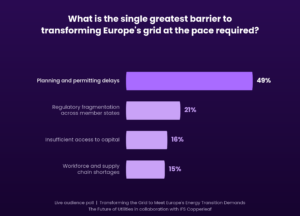
The panel added an important warning: today’s ranking may not hold for long.
Access to capital has been relatively straightforward until now, but the investment landscape will become more competitive as utilities across Europe launch major capital programmes simultaneously. Planning and permitting may be the most visible barrier today, but successful delivery will depend on addressing the full range of financial, regulatory, and resource constraints.
2. The question is no longer whether to invest, but where investment creates the greatest value
The challenge has shifted from “Can we build it?” to “What should we build first and can we demonstrate that it was the right decision?”
Electricity demand in the UK is forecast to nearly triple by 2050, driving unprecedented levels of grid investment. But larger settlements do not make investment choices easier. Utilities must decide how to balance new capacity with the replacement of ageing assets, while maintaining performance and managing risk. Every investment must compete for funding and be supported by clear, defensible evidence.
Both growth and replacement investments are necessary. The challenge is evaluating them consistently, understanding the value and risk associated with each option, and building a portfolio that balances immediate needs with long-term outcomes.
3. Climate resilience investment is hardest to justify before the storm hits
Storms in Portugal and the UK, floods and wildfires in Greece. Climate impacts featured in every operator’s story, and so did a shared frustration: when things go wrong, everyone supports the investment. Resilience investment is easy to support after an event but harder to justify before one.
Value models have to capture what’s hard to quantify, resilience, societal benefit, long-term risk reduction, and show it in advance, not in the post-storm inquiry. The case for resilience must be clear before the next crisis.
3. Stable, multi-year regulatory frameworks will unlock resilience in an uncertain market conditions
Grid assets last for decades, while many regulatory frameworks run for only three to five years. This gap creates uncertainty for operators, investors, lenders, suppliers, and the workforce.
Clear, stable, multi-year frameworks give the market confidence to invest, expand capacity, and build the skills needed to deliver the transition. Without predictability, decisions slow down, putting Europe’s net-zero targets at risk.
Watch the full webinar on demand
Explore the full discussion, including audience questions on curtailment, storage, data sovereignty, and who ultimately pays for the energy transition.