

How AI-Enhanced Asset Investment Planning Is Reshaping Capital Strategy
Executive Summary
Capital planning is no longer a once-a-year budgeting exercise — it is a continuous, enterprise-wide discipline that determines whether an organization can fund its future while defending every decision to regulators, investors and boards.
Capital-intensive organizations are under increasing pressure to do more with less. As a result, aging assets, constrained budgets, evolving sustainability expectations, operational disruption, and growing stakeholder scrutiny are forcing leaders to rethink how investment decisions are made.
Forward-looking organizations, whatever their sector, are adopting Asset Investment Planning (AIP) to make better investment decisions across their entire capital portfolio. In parallel, they are using artificial intelligence to extend how much data, how many scenarios and how many variables can be weighed before a decision is made.
This article explores why more data alone isn’t producing better capital decisions, how AI is enhancing the discipline of Asset Investment Planning, and how leading asset-intensive organizations — across industries — are turning enterprise data into enterprise-wide decision confidence.
Capital Strategy Has Become an Enterprise-Wide Challenge
Asset-intensive organizations have always had to make hard trade-offs. However, what has changed is the volume of data, the number of stakeholders, and the financial stakes riding on every capital decision.
Whether the asset base is a mine, a production line, a chemical plant, a port terminal or an airport, the same pressure applies.
Ageing assets increase the risk of costly, unplanned failures.
In addition, climate and ESG commitments compete directly with core reliability, throughput and modernization spending.
Meanwhile, regulators, investors and communities increasingly expect a transparent, auditable rationale behind every dollar deployed.
These pressures have direct consequences:
- Delayed or deferred investment
- Disputes between finance and operations
- Inconsistent risk assessment across business units
- Missed regulatory or ESG commitments
- Value left on the table across the portfolio
- Reduced confidence in the capital plan
For capital planning leaders, this is no longer solely a finance or engineering problem — it is an enterprise decision-making challenge that requires a shared, defensible framework across finance, operations and executive leadership.
Industry Insight
“The organizations that will out-compete their peers this decade won’t be the ones with the most data — they’ll be the ones that can turn that data into a defensible capital decision, consistently, at scale.”
Why More Data Isn’t Producing Better Decisions
Historically, many organizations prioritized investment based on:
- Asset age
- Budget availability
- Department-level requests
- Historical spending patterns
- Compliance minimums
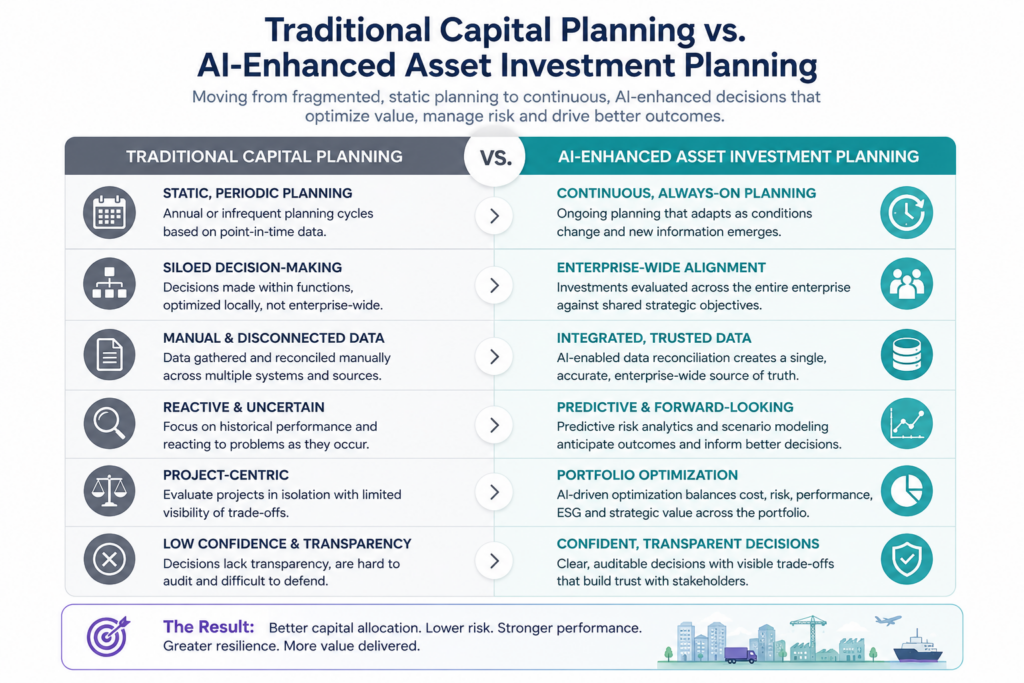
While these remain relevant inputs, the complexity of today’s capital environment requires a framework that can weigh far more variables at once — without becoming unmanageable.
| Traditional Planning | AI-Enhanced Asset Investment Planning |
| Asset age | Asset and enterprise risk |
| Departmental budgets | Enterprise-wide value optimization |
| Manual, periodic analysis | Continuous, scenario-based analysis |
| Individual project justification | Portfolio-level trade-off comparison |
| Historical performance | Predictive, forward-looking risk models |
| Static annual plans | Always-on, adaptive planning |
Modern capital planning asks a different question:
Which portfolio of investments delivers the greatest strategic and financial value for a given level of risk and available capital?
How AI Is Enhancing Asset Investment Planning
Organizations are increasingly directing investment — and analytical effort — towards capabilities that extend what capital planning teams can actually evaluate.
These include:
- Scenario modeling at scale
- Portfolio optimization across cost, risk and performance
- Automated data reconciliation across finance and operations
- Predictive risk analytics
- Decision support and trade-off visualization
- Continuous, always-on planning cycles
Rather than reacting once a year at budget time, organizations are moving towards continuous, AI-enhanced planning that adapts as conditions change — with every recommendation remaining transparent and auditable, not a black-box output.
From Asset Management to Asset Investment Planning
In fact, managing assets well is no longer enough.
Today’s asset-intensive organizations must also decide where, when and why they invest.
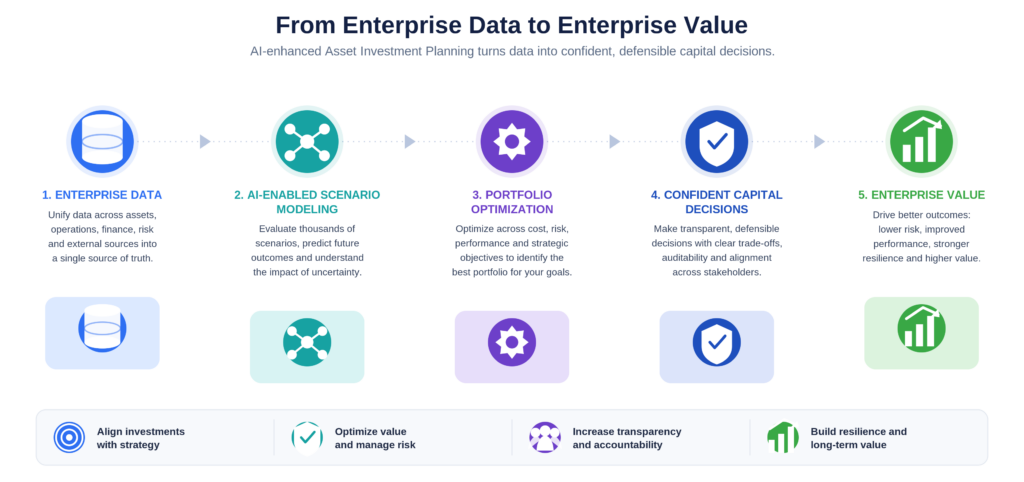
Asset Investment Planning enables organizations to evaluate thousands of competing investment options against a single, consistent value framework.
At the heart of this approach is the Copperleaf Value Framework™, which enables organizations to compare financial, operational, ESG, resilience and risk outcomes on a common economic scale.
Specifically, IFS Copperleaf‘s approach to Asset Investment Planning helps asset-intensive organizations evaluate trade-offs across cost, risk, performance and strategic objectives to support transparent, value-based investment decisions.
Instead of asking:
“Which projects should we fund this year?”
Decision-makers can ask:
- Which investments deliver the greatest strategic value?
- Which projects reduce the most enterprise-wide risk?
- How would this investment portfolio perform under tighter funding constraints?
- What risk does deferring this investment create?
Learn more: Asset Investment Planning Solutions
Building Enterprise-Wide Decision Confidence Through AI-Enhanced Planning
Decision confidence isn’t achieved through a single planning cycle.
Instead, it is built through thousands of consistent, transparent investment decisions made across the organization.
A structured, AI-enhanced Asset Investment Planning process typically includes five stages.
Step 1 – Understand Enterprise Risk Exposure
Identify assets and investments exposed to:
- Operational failure
- Regulatory non-compliance
- Climate and ESG risk
- Cybersecurity exposure
- Financial underperformance
- Reputational risk
Ultimately, combining asset condition data with financial and risk data creates a clearer picture of where investment is truly needed.
Step 2 – Understand Strategic Criticality
Not every investment contributes equally to corporate strategy.
Prioritize based on:
- Strategic alignment
- Safety and compliance implications
- Customer and stakeholder impact
- Enterprise dependency
- Cost of deferral
- Long-term value
Step 3 – Model Investment Scenarios at Scale
Rather than comparing a handful of options manually, AI-enabled scenario modeling allows planning teams to compare dozens of funding and risk scenarios instantly.
Questions include:
- What if capital is constrained by 10%?
- How would a shift in risk tolerance change the picture?
- What happens if a major investment is deferred?
- Which portfolio delivers the greatest value under uncertainty?
As a result, this scenario-based approach supports faster, more confident strategic decisions.
Step 4 – Optimize the Investment Portfolio
Portfolio optimization considers multiple objectives simultaneously, including:
- Risk reduction
- Asset and operational performance
- Budget constraints
- ESG and sustainability commitments
- Regulatory requirements
- Stakeholder and customer outcomes
As a result, this helps organizations extract the greatest possible value from constrained capital.
Step 5 – Continuously Review and Adapt
Capital conditions continue to evolve — budgets shift, risks emerge, priorities change.
Consequently, investment strategy should evolve with them, through continuous reassessment supported by live operational, financial and risk data.
Why Asset Investment Planning Matters
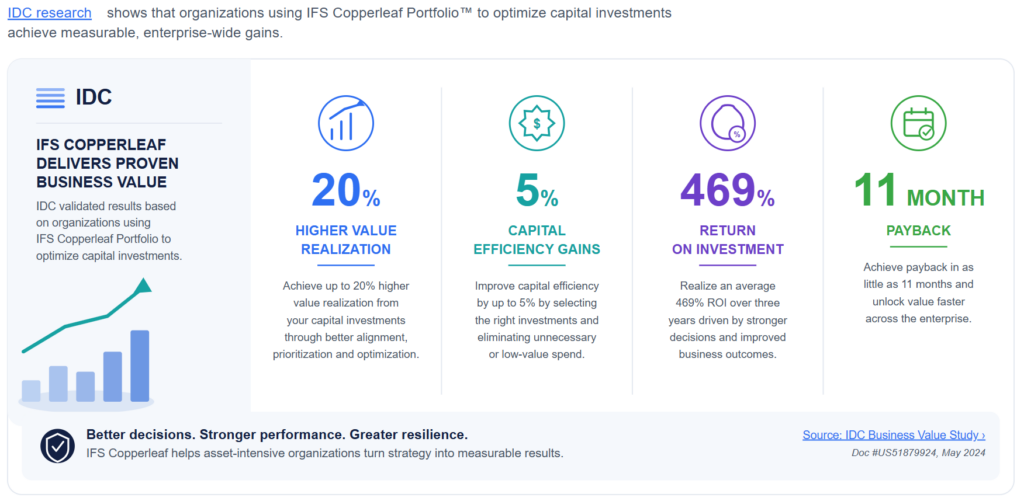
Independent research from IDC shows organizations using a mature, AI-enhanced approach to Asset Investment Planning report measurable gains, including:
- Up to 20% higher value realization from capital portfolios
- 5% gains in capital efficiency
- 469% average ROI
- 11-month average payback period
Beyond measurable ROI, organizations report stronger governance, greater enterprise-wide decision confidence, improved cross-functional alignment, and the ability to adapt investment plans as priorities evolve.
Related Resource: The Business Value of Asset Investment Planning (IDC Research)
Benefits and Challenges
Benefits
✔ Better strategic capital alignment
✔ Greater enterprise-wide decision confidence
✔ Transparent and defensible investment decisions
✔ Improved capital productivity
✔ Faster adaptation to changing business conditions
✔ Stronger governance and stakeholder confidence
Challenges
⚠ Legacy systems and fragmented data
⚠ Data quality and governance issues
⚠ Organizational silos between finance, operations and engineering
⚠ Budget pressures and competing priorities
⚠ Rapidly evolving risk and regulatory landscape
⚠ Balancing short-term operational needs with long-term strategy
What Leading Organizations Are Doing Differently
Progressive asset-intensive organizations, across sectors, are moving away from siloed, project-by-project decisions towards enterprise-wide investment optimization.
Instead of managing capital requests independently, they are:
- Linking every investment decision to corporate strategy
- Quantifying and comparing risk consistently across the portfolio
- Using AI-enabled scenario modeling to test trade-offs before committing capital
- Incorporating ESG and resilience objectives directly into planning
- Making the rationale behind every decision transparent and auditable
This shift is playing out across industrial and infrastructure sectors alike. In mining and industrials, for example, safety-critical asset renewal and production-critical equipment compete for the same constrained capital. Manufacturing and chemicals face a similar tension, where turnaround planning and process-safety investment must be sequenced against throughput targets. Transportation, ports and airports encounter it too, constantly weighing capacity expansion against resilience, safety and regulatory commitments. Regardless of industry, the value isn’t the software — it’s the decision confidence it enables at enterprise scale.
Download the Business Value of Asset Investment Planning
Want to see the full data behind these outcomes?
Download the independent IDC research on the business value of Asset Investment Planning.
Download the report: The Business Value of Asset Investment Planning
Why Asset Investment Planning Is Becoming a Competitive Advantage
As capital becomes harder to secure and easier to misallocate, the discipline behind how it’s deployed is becoming a genuine source of competitive advantage.
✔ Organizations that align capital decisions to strategy respond faster to change.
✔ Similarly, those that quantify value make more defensible investment decisions.
✔ Meanwhile, organizations that continuously optimize capital outperform peers relying on static planning cycles.
Key Takeaways
| Challenge | Strategic Response |
| Constrained capital budgets | Optimize the investment portfolio for value |
| Ageing, higher-risk assets | Prioritize based on enterprise risk and criticality |
| Regulatory and stakeholder scrutiny | Build transparent, auditable decision records |
| Fragmented finance/operations data | Automate data reconciliation and enable a shared view |
| Rising ESG and resilience expectations | Embed ESG and resilience directly into planning |
| Slow, periodic planning cycles | Move to continuous, AI-enhanced scenario modeling |
Summary
As capital investment becomes one of the defining strategic disciplines for asset-intensive organizations, the ability to make transparent, value-based and defensible decisions will increasingly separate market leaders from their competitors. Ultimately, Asset Investment Planning, enhanced by AI and grounded in a consistent value framework, enables organizations to invest with greater confidence today while building resilience for tomorrow.
Frequently Asked Questions
Why is AI becoming important to capital strategy?
Capital planning teams are being asked to weigh more variables — risk, ESG, regulatory, financial and operational data — than manual analysis can practically handle. As a result, AI extends how much data and how many scenarios can be evaluated before a decision is made, without replacing the judgment behind the decision.
What is Asset Investment Planning?
Asset Investment Planning is a structured discipline for evaluating investment options across an enterprise asset portfolio, enabling organizations to align capital decisions with cost, risk, performance and strategic objectives.
How does AI enhance Asset Investment Planning?
AI supports Asset Investment Planning through large-scale scenario modeling, portfolio optimization, predictive risk analytics and automation of data-heavy analysis — producing transparent, auditable recommendations rather than black-box outputs.
Why does enterprise-wide decision confidence matter?
Asset-intensive organizations operate under constrained budgets and intense regulatory scrutiny. As a result, enterprise-wide decision confidence ensures capital is directed to its highest-value use and that every decision can be defended to boards, investors and regulators.