Why Sustainability Investments Need Better Investment Decisions
Executive Summary
Asset Investment Planning is becoming critical for rail infrastructure owners facing climate change, decarbonization mandates, rising passenger expectations, ageing assets, and tightening budgets. Sustainability is no longer a side commitment. It is now a core consideration in capital planning.
However, sustainability investment does not compete for funding in isolation. Rail organizations must decide whether to electrify a corridor, replace signaling, renew a flood-prone bridge, invest in flood mitigation, or support biodiversity initiatives. Each project draws from the same limited capital budget.
Traditionally, planning approaches struggle to compare these investments on consistent terms. Consequently, organizations often find it difficult to justify sustainability projects alongside safety, reliability, and renewal programs.
To address this challenge, a growing number of rail organizations are adopting Asset Investment Planning (AIP). This structured, decision-analytics-led approach evaluates thousands of competing investment options—including sustainability initiatives—against a common measure of cost, risk, value, and performance.
Ultimately, these decisions determine whether a network remains safe, reliable, resilient, and available for the passengers and freight operators who depend on it.
This article explores why sustainability initiatives often struggle to compete for capital, how decision analytics and portfolio optimization transform investment decisions, and how organizations such as Network Rail are turning sustainability ambitions into funded, defensible action.
Why Sustainability Investment Struggles to Compete for Capital
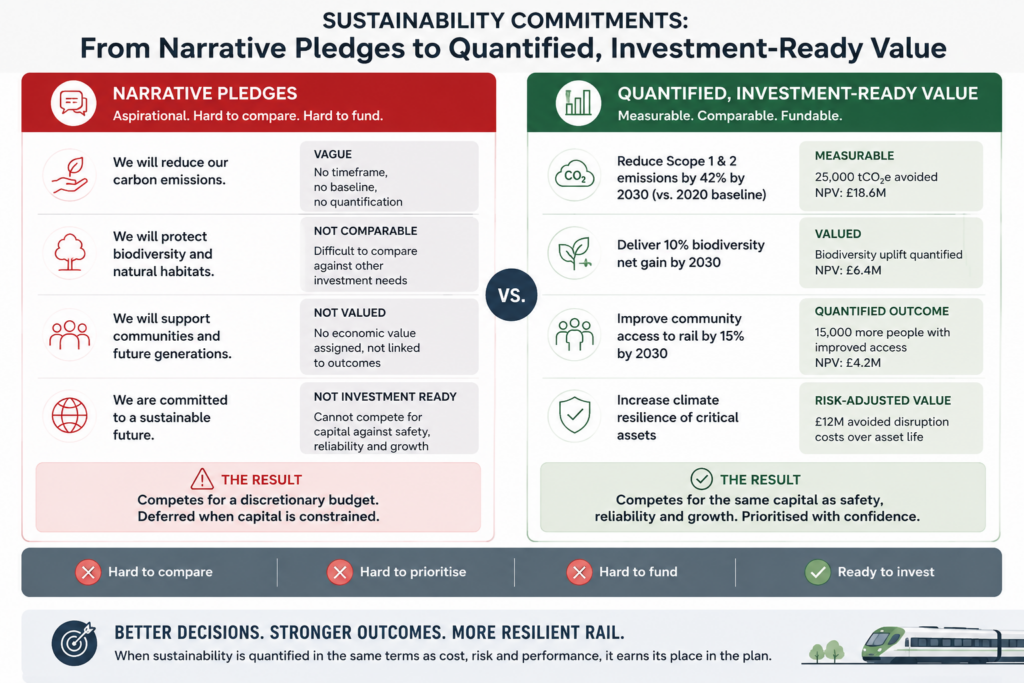
Many sustainability targets are expressed in measures that resonate with environmental teams. Examples include tonnes of CO₂ avoided, biodiversity net gain, community outcomes, and ESG performance metrics.
By contrast, capital planning decisions typically rely on financial and operational measures such as risk reduction, safety improvements, service reliability, and cost avoidance.
When these two perspectives remain disconnected, sustainability projects are often assessed separately from the broader capital portfolio. Consequently, they compete for discretionary funding rather than being evaluated alongside renewals, safety improvements, and growth projects.
When budgets become constrained, projects that cannot demonstrate value using comparable criteria are often deferred first. Unfortunately, delaying these investments can introduce significant operational, financial, and reputational risks.
The urgency of the issue is clear. The European Union Agency for Railways has identified more than 13,000 extreme-weather events affecting Europe’s railways during the past two decades, with incidents continuing to rise. Therefore, climate resilience and decarbonization are increasingly viewed as board-level priorities rather than optional initiatives.
Moreover, investors, regulators, and boards now expect measurable evidence of progress rather than broad sustainability commitments. To meet these expectations, organizations need better investment decisions—not simply better reporting.
Industry Insight Investment decisions made without a consistent way to compare them rarely survive a constrained capital plan.
Why Looking at Projects in Isolation Isn’t Enough
When faced with sustainability targets, it can be tempting to prioritize the most visible project and call it progress. An electrification program, flood defense initiative, or signaling upgrade may appear compelling when assessed individually.
However, no standalone project can reveal whether it represents the best use of limited capital.
For example:
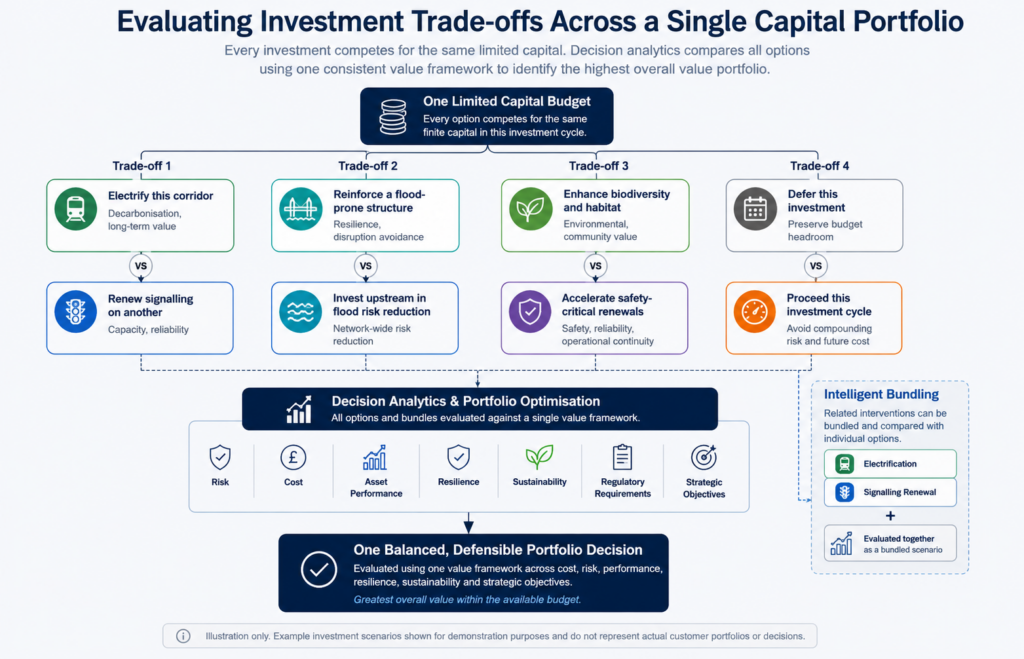
Should a network electrify one corridor or replace ageing signaling elsewhere?
Should it renew a flood-prone bridge or invest in wider flood-risk reduction measures?
Should it accelerate biodiversity initiatives or focus on safety-critical renewals?
Every rail organization faces similar trade-offs during each investment cycle. Furthermore, each decision affects network availability, operational resilience, service continuity, and passenger confidence.
As a result, evaluating investments one project at a time often leads to inconsistent decisions that become difficult to defend later.
Leading organizations therefore compare all investment options against consistent measures of cost, risk, value, and performance. This portfolio-level perspective enables more transparent and defensible capital planning.
A New Approach: Decision Analytics and Portfolio Optimization
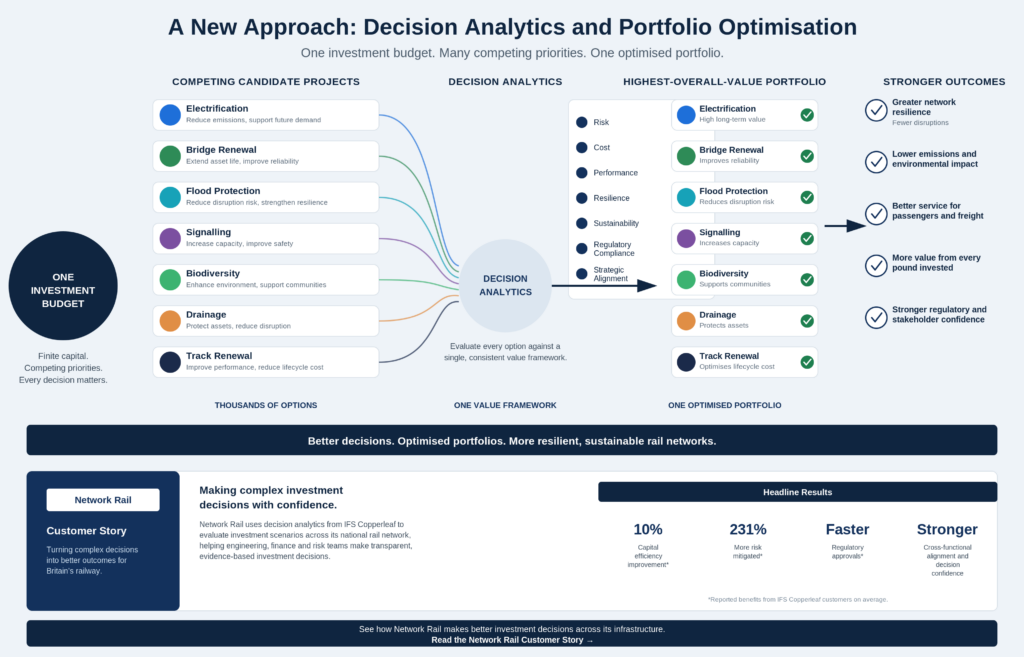
Decision analytics enables organizations to compare thousands of potential investments within a single framework.
Rather than relying on departmental priorities or subjective judgment, organizations can evaluate safety, reliability, growth, and sustainability projects using consistent evidence.
Network Rail, which manages Britain’s national rail network, is one organization that has adopted this approach. Using decision analytics from IFS Copperleaf, the organization evaluates multiple investment scenarios and supports transparent, evidence-based decision-making across engineering, finance, and risk functions.
As a result, stakeholders gain greater confidence that investment decisions align with both strategic objectives and operational requirements.
From Asset Management to Asset Investment Planning
Managing assets well is no longer enough. Rail organizations must also decide where, when and why to invest, and increasingly, sustainability outcomes are part of that same decision, alongside the operational resilience that keeps services running reliably.
IFS Copperleaf’s Asset Investment Planning solutions, Copperleaf Portfolio and the Copperleaf Value Framework, apply decision analytics to evaluate competing investment options, including decarbonization and resilience projects, against cost, risk, performance and strategic objectives on one consistent scale. This includes ESG quantification: translating decarbonization and social outcomes into the same economic terms as cost and risk, so sustainability investment can be compared directly against every other option.
Rail operators that adopt value-based planning report measurable benefits.
These include:
Up to 10% gains in capital efficiency
Up to 231% more risk mitigated
Faster regulatory approvals
Greater transparency in investment decisions
These outcomes reflect more than two decades of experience helping infrastructure organizations optimize billions of dollars of capital investment using decision analytics.
Building Sustainable Railways Through Better Investment Decisions: Five Steps
Step 1: Focus on Long-Term Value
Organizations should begin by asking which investments create the greatest long-term value.
Important considerations include:
Carbon reduction outcomes
Climate resilience improvements
Biodiversity impact
Community and social benefits
Safety improvements
Reliability and availability outcomes
By defining outcomes clearly, organizations can evaluate sustainability initiatives alongside core operational investments.
Step 2: Assign Value Consistently
Next, organizations should establish a consistent value framework.
This framework translates sustainability, resilience, and business outcomes into comparable economic terms. As a result, decision-makers can compare investments using a shared language of value.
Strengthen a vulnerable structure or reduce upstream flood risk?
Expand biodiversity programs or accelerate safety upgrades?
Invest now or defer funding until later?
In addition, Intelligent Bundling enables organizations to evaluate combinations of related projects. This approach helps reveal opportunities that may generate more overall value than standalone investments.
Step 4: Optimize the Portfolio
Individual project scoring provides useful insight, but it does not reveal whether the overall portfolio delivers the greatest value.
Furthermore, portfolio optimization tools can assess thousands of scenarios—far beyond the capabilities of spreadsheets and manual evaluation techniques.
Step 5: Review and Adapt Continuously
Capital plans should evolve as priorities, budgets, and climate risks change.
Therefore, organizations should review investment strategies regularly and use the same evidence for operational planning, board reporting, and regulatory disclosure.
This creates a transparent and defensible decision-making process over the long term.
Meeting Investor, Regulator, and Board Expectations
Investors, regulators, and boards expect organizations to demonstrate that sustainability commitments are supported by tangible investment decisions. Consequently, organizations need an auditable record of how projects were evaluated and prioritized.
A consistent value framework provides finance, engineering, and sustainability teams with a shared foundation for decision-making. Additionally, it supports regulatory submissions and governance requirements without turning capital planning into a compliance exercise.
Why Value-Based Asset Investment Planning Matters
Organizations that adopt Asset Investment Planning achieve several important benefits:
Better prioritization of sustainability and resilience investments
More transparent and defensible decisions
Stronger alignment between finance, engineering, and sustainability teams
Improved portfolio optimization across cost, risk, performance, and sustainability objectives
Greater capital efficiency
Enhanced network resilience and service continuity
Increased passenger confidence
Ultimately, value-based decision-making improves how organizations allocate scarce capital across the entire asset portfolio.
What Leading Rail Organizations Are Doing Differently
Progressive rail infrastructure owners are integrating sustainability directly into core capital planning processes.
Instead of treating sustainability as a separate reporting exercise, they are:
Comparing sustainability investments with safety and reliability projects using a common framework
Using portfolio optimization instead of isolated project scoring
Bundling decarbonization and renewal initiatives where appropriate
Supporting board, investor, and regulatory reporting with consistent evidence
Connecting sustainability outcomes to operational resilience and network availability
Using Asset Investment Planning as a foundation for long-term resilience
As a result, organizations create greater confidence that sustainability commitments are backed by funded, defensible action.
Key Takeaways
Summary
The future of sustainable rail infrastructure will be determined not by the ambitions organizations set, but by the investment decisions they make. By embedding sustainability into value-based Asset Investment Planning, rail organizations can priorities investments that strengthen resilience, improve performance and deliver measurable environmental outcomes, while keeping their networks safe, reliable and always-on.
Frequently Asked Questions
Why does sustainability investment struggle to compete for capital?
Sustainability targets are often set in units, tonnes of carbon, biodiversity metrics, that don’t map onto the financial and risk criteria used to priorities capital. Without a common value framework, these projects compete for a separate, discretionary budget and are often the first to be deferred when funding tightens.
What is Asset Investment Planning?
Asset Investment Planning is a structured approach to evaluating investment options, including sustainability and decarbonization projects, using decision analytics and portfolio optimization, so capital is prioritized based on value, risk, performance and strategic objectives.
Why is portfolio optimization important for sustainability investment?
Evaluating projects individually can’t show whether a given investment is the best use of finite capital. Portfolio optimization compares thousands of candidate projects, sustainability-linked and otherwise, against the same measures simultaneously, revealing the combination that delivers the greatest overall value.
How does decision analytics build investment confidence?
By evaluating every option against a single, consistent value framework, decision analytics gives finance, engineering and sustainability teams a transparent, auditable basis for every investment decision, making capital plans easier to defend to boards, regulators and investors.
Does this replace sustainability or ESG reporting?
No. Reporting remains necessary for transparency and compliance. Value-based Asset Investment Planning complements it by giving teams a way to fund sustainability commitments through the same capital planning process used for every other investment.
How does this support investors, regulators and boards?
A consistent value framework creates an auditable record of how every investment decision, sustainability outcomes included, was quantified and prioritized, giving finance and sustainability teams a shared evidence base for regulatory submissions and board reporting.
How does sustainability investment support network availability and resilience?
When sustainability projects are evaluated on the same basis as safety and reliability work, resilience investment, flood mitigation, electrification, structural renewals, directly reduces the extreme-weather and asset-failure disruptions that take a network offline, improving network availability and reducing disruption for passengers and freight.