

Turn asset data into defensible investment plans and make every trade-off visible and explainable.
IFS Copperleaf empowers organizations managing critical infrastructure to optimize capital deployment, turning real-world asset data into defensible investment plans, making trade-offs transparent, and creating a coherent chain of evidence that stands up to executive, board, and regulatory scrutiny.
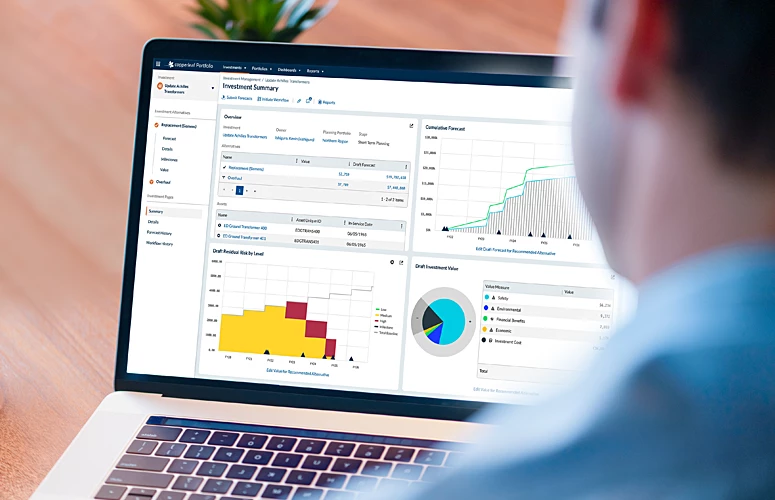
Asset Investment Planning (AIP) explained
Asset investment planning (AIP) is a structured, value-based approach to deciding where, when, and how to invest capital in physical assets. Using a common economic framework, AIP balances cost, risk, performance, and strategic outcomes across an entire portfolio — producing investment plans that are optimized, defensible, and aligned with long-term organizational goals.
Why AIP Matters Now
Asset-intensive organizations face a sharper set of pressures than they did a decade ago. Aging infrastructure, constrained capital budgets, accelerating decarbonization commitments, and tightening regulatory scrutiny are arriving simultaneously — and traditional planning methods were not built for this level of complexity.
Spreadsheet-based capital planning, annual budget cycles, and siloed asset lists cannot keep pace. They produce plans that are hard to defend, difficult to adjust, and disconnected from the strategic and financial goals of the wider organization.
Asset investment planning provides a repeatable, evidence-based structure for making investment decisions that can be explained to executives, regulators, and boards — and that remain reliable as conditions change. By aligning with the principles of ISO 55000, AIP ensures that value, risk, and organizational context drive every capital decision.
The Four Pillars of Asset Investment Planning
Effective AIP is built on four interdependent capabilities. Together they give organizations the structure to plan confidently, adapt quickly, and defend every capital decision.
Every investment decision is aligned to strategy, value, and risk — not just urgency or politics.
- Replace intuition-driven prioritization with quantified, comparable value across investments.
- Balance cost containment, growth, and technology investment within constrained budgets.
- Ensure every project in the plan can be traced back to a strategic objective.
- Support rate cases and regulatory submissions with evidence-backed investment rationale.
- Use a consistent value framework that travels from asset data all the way to board-level investment decisions.
Make decisions in real time as conditions change, because certainties are rarer and the cost of being locked into a single plan is higher.
- Run rapid what-if scenarios across budget cuts, demand surges, climate events, and strategic pivots.
- Stress-test funding paths and surface the impact of trade-offs instantly.
- Respond to affordability pressures without losing sight of risk and reliability commitments.
- Avoid being locked into last year’s plan when the operating environment has shifted.
- Build regulatory submissions that show multiple defensible paths, not a single fragile plan.
Every investment decision is auditable, explainable, and connected to expected outcomes in the plan.
- Create a traceable chain of evidence from asset data to investment decision to expected outcome.
- Govern assumptions and decision criteria so plans are consistent across teams and cycles.
- Produce and surface regulation-ready rationale that explains what changed and why.
- Reduce “should we?” by replacing ongoing debate with one coherent, evidence-backed view.
- Support peer review and accountability with documented rationale for every investment in the plan.
Bind the investment plan to asset data, financial systems, and capital planning goals — ready for any scenario in one system.
- Move from asset-level data and interventions to enterprise investment plans without losing the chain of evidence.
- Ensure asset strategy outputs feed directly into portfolio-level investment decisions with no manual re-entry.
- Align operations, asset management, and capital planning around shared goals.
- Reduce internal conflict and speed cross-functional alignment.
- Measure planned vs actual outcomes and feed learnings back into future cycles.

What Asset Investment Planning Delivers
Organizations using IFS Copperleaf for asset investment planning report measurable outcomes across planning efficiency, capital productivity, and regulatory confidence.
better planning efficiency — teams focus on analysis and judgment rather than data assembly.
as many bundled interventions — improving capital efficiency by coordinating work that would otherwise be planned separately.
to create investment plans — faster scenario and less manual rework across planning teams.
“PG&E invests $10-20 billion in its system each year. By shifting to bundled, optimized planning with IFS Copperleaf, we’ve identified the opportunity to realize up to $3.7 billion in potential efficiencies over six years. We can reinvest these savings to deliver even more value for customers.”

We Didn’t Enter The AIP Market.
We Created It.
IFS Copperleaf was founded in 2000 and launched Asset Investment Planning as a new category of enterprise software. For over two decades, we have been the clear global market leader — managing billions of dollars in assets for the world’s largest critical infrastructure operators. We achieve the highest product capability scores in the Verdantix Green Quadrant for AIP and earn top ratings on Gartner Peer Insights.
While new competitors have entered the space, no one has replicated the depth of our methodology, the breadth of our utility deployments, or the deterministic rigor of the Copperleaf Value Framework. When buyers choose IFS Copperleaf, they are choosing the company that wrote the playbook — backed by the enterprise scale of IFS.
How AIP Differs from Traditional Capital Planning
Traditional capital planning produces a ranked list — built from siloed inputs, updated annually, weighted toward cost and compliance, and difficult to defend under scrutiny. Asset investment planning is a different approach at every level.
| Capability | Traditional capital planning | IFS Copperleaf AIP |
| Value framework | Generic scoring or consultancy templates; applied from the outside. | Copperleaf Value Framework — deterministic, calibrated to each client’s own definition of value. |
| Asset data to investment plan | Financial or project data only; rarely linked to asset condition or risk. | Full chain: asset condition → risk quantification → intervention logic → portfolio optimization. |
| Scenario modeling | Single plan or static rankings; no portfolio optimizer. | Simultaneous optimization across value, risk, budget, constraints, and time horizons. |
| Regulatory defensibility | Financial reporting outputs only; limited traceability. | Traceable, auditable investment rationale from asset data to plan — built for rate cases and board scrutiny. |
| Category depth and tenure | 2–30 years in market; many diverse platforms or consultancy-backed products. | 25+ years in AIP — created the category; deepest utility deployment base globally. |
| Enterprise ecosystem | Standalone or limited integrations. | Native IFS platform connection (ERP, EAM, FSM); SAP-certified; broadest enterprise connectivity. |
AIP is also distinct from Enterprise Asset Management (EAM), Enterprise Resource Planning (ERP), and Asset Performance Management (APM). Each plays a role in asset-intensive organizations — but none was purpose-built to optimize capital investment decisions across a whole portfolio against a value framework. For a deeper comparison, see Asset Investment Planning vs Capital Planning.

How Asset Investment Planning Works
Asset investment planning is structured and repeatable, and ensures that capital is directed to the highest ‑value priorities by:
- Identifying investment needs across the portfolio based on asset condition, risk, and performance data.
- Evaluating each option against the organization’s value framework — translating different outcomes onto a common economic scale.
- Applying constraints: budgets, resources, outage windows, regulatory requirements, and risk tolerances.
- Running scenario analysis to understand how trade-offs shift under different futures and budget levels.
- Optimizing the portfolio to identify the highest-value combination of investments within constraints.
- Producing a plan with a clear governance trail — showing why each investment was selected, what value it delivers, and what alternatives were considered.
- Tracking delivery and refreshing the plan as conditions evolve.
Benefits of Asset Investment Planning

Sharper Prioritization
The most valuable enterprise-wide investments become clear, regardless of asset classes or business units.

Stronger Defensibility
AIP provides an evidence based rationale for every investment, supporting stronger regulatory submissions and internal governance.

Cross Functional Alignment
A shared value framework unites finance, operations, engineering, and strategy teams around a single plan.

Faster Analysis
Leaders can quickly explore “what‑if” scenarios such as budget change, risk, or strategic pivots without undertaking weeks of manual rework.
Who Asset Investment Planning Is For
- Build long‑term renewal strategies
- Understand asset health and risk
- Justify investment needs
- Align investments with corporate strategy
- Test long‑term scenarios
- Strengthen business cases
- Improve capital efficiency
- Strengthen regulatory submissions
- Enhance budget forecasting
- Prioritize operational programs
- Balance reliability, safety, and cost
- Coordinate outages and resource constraints

Related Asset Investment Planning Assets
White Paper
Grid Modernisation Guide
Brochure
From Better Investment Decisions to Better Regulatory Outcomes
Brochure
Build the Modern Grid. Make Every Investment Count.
FAQs
1. Why is asset investment planning important?
AIP gives organizations a repeatable, evidence-based method for making capital decisions that can be optimized, defended, and adapted as conditions change. It replaces static, siloed, and often politically driven approaches with a structure that produces plans capable of withstanding executive, board, and regulatory scrutiny.
2. What is the Copperleaf Value Framework?
The Copperleaf Value Framework is the proprietary, deterministic decision-making methodology at the core of IFS Copperleaf’s AIP solution. It quantifies the value of every investment on a common economic scale — incorporating financial and non-financial outcomes including safety, environmental performance, reliability, regulatory risk, and strategic alignment — calibrated to each organization’s own definition of value. It is what makes AIP plans defensible under scrutiny, not just internally useful.
3. Do I need perfect data to start AIP?
No. AIP does not require perfect data — it requires the information you are already using to manage your assets. Most organizations begin with existing data and see both data quality and planning confidence improve as the process matures over time.
4. How does AIP support regulatory defensibility?
AIP produces a traceable chain of evidence from asset condition data to investment decision to expected outcome. Every investment in the plan is backed by documented rationale — what value it delivers, what alternatives were considered, and why it was selected. This traceability is specifically built to support rate cases, regulatory submissions, and board-level governance.